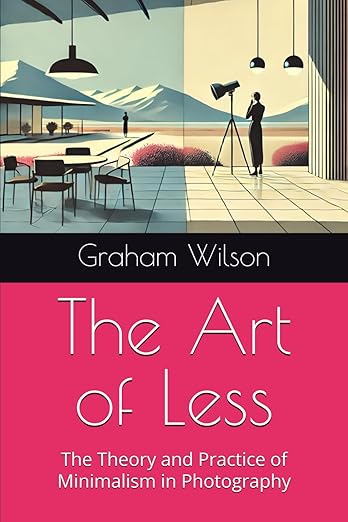
Author: Graham

  • Book: “The Art of Less”

    Book: “The Art of Less”

    The Art of Less explores minimalist photography, focusing on simplicity, clarity, and intentionality. This book bridges the gap between basic photography manuals and complex academic literature, offering both practical and theoretical insights into the minimalist approach. It emphasizes that minimalist photography is not just about reducing visual elements but about revealing the essence of a subject through restraint and thoughtful composition.

    Minimalism in photography challenges the photographer to make intentional choices about what to include and, more importantly, what to exclude. It draws from the broader minimalist movement in art and design, which focuses on the idea that “less is more.” Minimalist photographers aim to distill scenes into their essential components, often using negative space, limited color palettes, and simple geometric shapes to create powerful images. The result is a sense of calm, balance, and emotional depth.

    One of the key concepts in minimalist photography is negative space, which plays a critical role in directing attention to the subject and creating a feeling of openness and simplicity. Negative space is not merely empty space but a crucial element that provides context, balance, and mood. It helps the photographer emphasize the subject’s significance, evoke emotions like solitude or tranquility, and enhance the overall impact of the image.

    Texture and pattern are important aspects of minimalist photography as well, adding layers of interest and depth without complicating the composition. Texture, particularly when emphasized through lighting and close-up photography, can bring an image to life, engaging the viewer’s tactile senses. Similarly, patterns—whether found in nature or architecture—introduce rhythm and structure to a photograph, creating a sense of harmony and order.

    The philosophy of minimalism goes beyond the visual and technical aspects of photography. It is a way of seeing the world more clearly, engaging with one’s surroundings mindfully, and focusing on the essentials. Minimalist photography encourages the photographer to slow down, be fully present, and appreciate the beauty in simplicity. This approach fosters a deeper connection between the photographer and the subject, often resulting in images that are not only visually compelling but emotionally resonant.

    Storytelling through minimalist photography is another key theme explored in the book. While minimalist images may appear simple, they can convey complex narratives and deep emotions. By isolating a subject or using suggestion and symbolism, photographers can tell powerful stories with minimal elements. The ability to evoke emotion and meaning through reduction is one of the most challenging yet rewarding aspects of minimalist photography.

    As minimalism becomes a broader lifestyle choice, the book also touches on how this philosophy can be applied beyond photography. Minimalism encourages living with intentionality, reducing distractions, and focusing on what truly matters—principles that can be applied to everyday life as well as to creative practice. Whether in photography, design, or daily living, minimalism emphasizes clarity, mindfulness, and the pursuit of simplicity.

    The book offers numerous practical exercises for photographers looking to develop a minimalist style. These exercises encourage readers to experiment with composition, light, and shadow, and to think critically about their creative choices. The goal is to help photographers refine their skills and create a cohesive body of work that reflects the minimalist ethos.

    Ultimately, The Art of Less teaches that minimalist photography is about more than aesthetics—it is a discipline that requires focus, intention, and continuous practice. Through this journey, photographers learn to find beauty in simplicity, to convey meaning with fewer elements, and to create images that resonate deeply with viewers. Minimalism, in both photography and life, offers a way to focus on what is essential, allowing clarity, depth, and meaning to emerge.

    ISBN: 979-8338616048 | £7.99 PBK | £3.99 EBK | Published 08/09/2024

  • Course: Community Wellbeing – Digital Photography for Beginners

    Course: Community Wellbeing – Digital Photography for Beginners

    Delighted that our third year of fully-funded therapeutic photography is approved and ready for enrollment.

    Please check out the page at Activate Learning and, if you qualify, then do enrol: Community Wellbeing – Digital Photography for Beginners – Activate Learning – Adult Education

    The sessions are intended to be of particular help for people who experience anxiety or depression that lead them to avoid social settings, or to have the confidence to go out in public and enjoy the experience.

    NB These sessions will improve people’s emotional well-being, but are NOT a substitute for personal therapy.

  • Book: “The Empathic Lens”

    Book: “The Empathic Lens”

    Creating Intimate Visual Narratives with Photography

    “The Empathic Lens” by Graham Wilson is a comprehensive guide for photographers who wish to create intimate visual narratives. The book emphasises the power of visual storytelling as a means to communicate deeply personal and emotional stories that transcend cultural and language barriers. Your journey through this book will enhance your ability to connect with your audience on a profound level by delving into the personal, vulnerable, and deeply human aspects of life.

    You will explore the concept of intimacy in visual storytelling, learning how to convey closeness and personal connection through your images. This involves developing a keen sense of observation and a deep understanding of your subjects, often building trust and spending significant time with them to capture moments that reveal their essence. By doing so, your work will evoke empathy and a sense of shared humanity among your audience.

    The psychological impact of intimate storytelling is a crucial theme. As a visual storyteller, you will embark on a journey of self-discovery and emotional exploration. This process can be both cathartic and challenging, requiring you to confront and express your vulnerabilities. The audience, in turn, experiences a deep emotional connection with your work, fostering empathy and understanding.

    The historical context provided in the book highlights how pioneers like Dorothea Lange, Walker Evans, Ingmar Bergman, and François Truffaut used their mediums to document personal struggles and explore deeply personal themes. Contemporary artists like Nan Goldin and Sally Mann continue this tradition, pushing boundaries and challenging conventional notions of beauty and propriety.

    Developing a unique visual language is essential for effective storytelling. You are encouraged to experiment with different techniques and styles, honing your personal style and voice. The relationship between form and content in your work is crucial, with visual choices enhancing and supporting the story you are telling. Crafting a narrative involves arranging your images to create a coherent and engaging story, considering structure, pacing, character development, and setting.

    Mastering technical aspects such as lighting, composition, and camera settings is vital for conveying your stories effectively. You are also introduced to multimedia storytelling, incorporating elements like text, sound, and video to add new dimensions to your narratives.

    Finding inspiration is a continuous process, drawing from personal experiences, other artists’ work, literature, music, nature, travel, and current events. Techniques for fostering creativity include mindfulness, experimentation, collaboration, and continuous learning. Overcoming creative blocks involves changing your environment, setting small goals, using prompts, revising old work, and embracing constraints.

    Sharing your work is an important part of the storytelling process. Building an audience through social media, exhibitions, and publications allows you to create connections and spark conversations. Ethical considerations are paramount, ensuring your work respects and accurately represents your subjects.

    Reflecting and growing as a visual storyteller is an ongoing process. Regular reflection on your work, seeking feedback, and staying curious and open to new ideas will help you evolve. The book encourages you to embrace your journey, using the practical advice, inspiration, and insights provided to become a more effective and expressive visual storyteller. Through “The Empathic Lens,” you will learn to create powerful, intimate visual narratives that resonate deeply with your audience.

    ISBN 979-8332057083 – Paperback £11.99 – 4 July 2024 – https://amzn.to/3WlyPTV

  • Course: “Emotions and Images: Using Psychology to Inform Our Photography”

    Course: “Emotions and Images: Using Psychology to Inform Our Photography”

    PLEASE NOTE – THIS COURSE IS FULLY BOOKED

    Sat 20 Jul 2024 – Sat 27 Jul 2024, Oxford

    Overview

    This course explores ways of conveying emotions through photography. 150 years ago, Darwin published “On the Expression of Emotions…” and, in 1908, Titchener introduced the concept of ‘empathy’. Drawing on contemporary insights from psychology, anthropology, and sociology, we attempt to apply these practically.

    Through daily workshops, Oxford locations, and exciting practical activities, we develop ways to provoke an emotional response with photography, consider the implications of doing so, and reflect on the opportunities that this presents. Whether you have a sophisticated DSLR, or prefer a smartphone, you should discover ways of adding new depth to your work. No prior experience with photography is necessary.

    This course is part of the Oxford University Summer School for Adults (OUSSA) programme.

    Programme details

    Seminars

    Participants are taught in small seminar groups of up to 12 students, and receive two one-on-one tutorials with their tutor.

    Sunday

    • Seminar 1: Overview and Camera Essentials
    • Seminar 2: On the expression of emotions in humans

    Monday

    • Seminar 3: The range of human emotions
    • Seminar 4: The history of emotions

    Tuesday

    • Seminar 5: Empathy and the emotional response
    • Seminar 6: Provoking an emotional response

    Wednesday

    • Seminar 7: Emotion and environment
    • Seminar 8: Beyond provocation – stories that move people

    Thursday

    • Seminar 9: Emotion and art
    • Seminar 10: Presenting our work

    Friday

    • Seminar 11: Portfolio review (the ‘crit’) – the course assessment
    • Seminar 12: The ‘crit’ (cont.) then Reflection and purpose in photography

    FURTHER DETAILS HERE: https://www.conted.ox.ac.uk/courses/emotions-and-images-using-psychology-to-inform-our-photography

  • Course: “Therapeutic Photography: An Introduction”

    Course: “Therapeutic Photography: An Introduction”

    17/05/25 – Oxford – Saturday 9:45am to 5:00pm

    More Information & To Book (do so quickly as places fill FAST)

    Unlock the transformative power of imagery with our comprehensive Therapeutic Photography course. This unique educational offering is designed for individuals eager to explore how photography can be used as a powerful tool for emotional healing and personal expression. 

    In our one-day intensive course, participants will embark on a journey through four distinct modules, each lasting 1.25 hours, that cover both the theory and practice of Therapeutic Photography. We begin with an Introduction to Therapeutic Photography, where you will learn about the origins, key theories, and the distinction between related practices like phototherapy. 

    The second session focuses on The Mechanics of Therapeutic Photography, teaching you the essential skills of camera operation, photographic techniques, and how to create environments conducive to emotional expression. This practical module ensures that participants can handle equipment and techniques with confidence, applying them in ways that foster deep personal and subject reflection. 

    Our third module, Therapeutic Photography in Practice, delves into real-world applications, showcasing how this method has been successfully implemented in various settings. Through case studies and interactive discussions, you will understand the dynamics of photo-elicitation, self-portraiture, and the critical ethical considerations that ensure respect and confidentiality. 

    The final session, Integration and Professional Practice, guides you on how to integrate these practices into professional settings. Whether you’re a therapist, counsellor, or educator, you will learn how to design and implement a therapeutic photography programme that aligns with your professional environment. 

    Ideal CPD for professionals in mental health, educators, and anyone interested in the intersection of art and therapy. Harness the therapeutic potentials of photography, enhancing your professional toolkit and personal growth journey. 

    PLEASE BRING A DIGITAL CAMERA WITH YOU – THIS CAN BE OF ANY KIND (INCLUDING A SMARTPHONE) – IDEALLY HAVE THE MEANS OF SHARING ONE OR TWO IMAGES TAKEN ON THE DAY WITH THE TUTOR.

    Please note: this event will close to enrolments at 23:59 BST on 14 May 2025

  • Course: “Advanced Coaching”

    Course: “Advanced Coaching”

    28/04/25 – 14/07/25 – Oxford – Mondays 6:30pm to 9:30pm

    More Information & To Book (do so quickly as places fill FAST)

    Helping any coach deepen their practice in various ways: enhancing intervention skills, better understanding clients’ needs, drawing on evidence, exploring attitudes to work/clients, and expanding client bases and professional standing.

    This course promises to be an exciting departure from traditional advanced programmes that generally offer intense immersion in one particular model but do little to help the coach develop their own practice in ways that are critical to them.

    You may be a business, life, sports, health, or financial coach; work in corporate, private or public sectors; with in-house, external, or assigned clients (paying or provided with your services for nothing); with years of experience, or just be beginning. Whatever your situation, your practice will be deepened and developed as a result of attending.

    The course is particularly suited to students who have completed an initial coaching programme, whether recently or some time ago, and are keen to expand their practice.

    Over ten weeks, you will be supported as you develop plans, identify key areas, gain peers to work alongside, and be guided and encouraged as you put those plans into practice.

    There will be opportunities to enhance your intervention skills, better understand clients’ needs, draw on evidence rather than hearsay, explore your own attitudes to work and clients, expand client numbers, and build your professional standing.