There was once a president who loved crowds more than policy. He filled his days with rallies and long speeches about himself. What he feared most was being seen as weak.
Two slick advisers came to him. They said they could make a suit so fine that only true patriots could see it. Anyone who doubted would show themselves to be un-American. This pleased the president. He thought: Now I will know who is loyal and who is not.
The advisers set up their stage. They had no cloth at all. They waved their arms and said, “Look at this fabric. It shines like gold. It is stitched with freedom itself.” The president saw nothing, but he dared not say so. He thought, If I cannot see it, others will call me a traitor.
His aides and party leaders came in. None of them could see a thing, but all cried out, “Magnificent!” They feared being cast out as weak or disloyal.
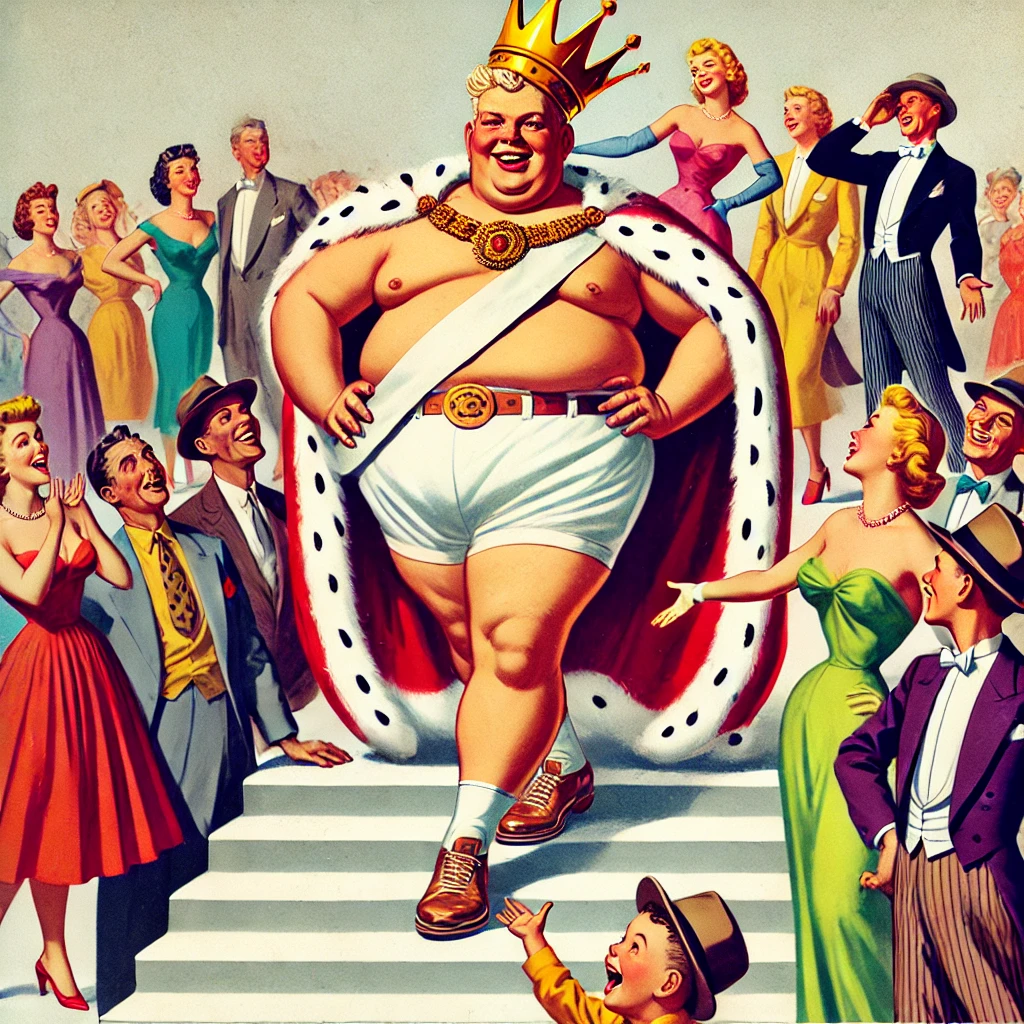
At last the day of the parade came. The president strode out, waving to the crowd in his new suit. The networks filmed him, and the commentators said how strong he looked. But the people, standing in the heat, saw only a man in his underwear.
A child, sitting on her parent’s shoulders, shouted, “He has nothing on!” The crowd fell silent. Then more voices took up the cry. Soon the square was full of laughter and anger mixed together.
The president flushed, but walked on, chin high, for he thought: If I keep marching, perhaps they will believe the lie after all.
An account of the entrances and exits of both humans and bulls
El Ruedo
In everyday English people just say “the arena”, but in Spanish bullfighting language ruedo is the proper term for the circular performance space where the bull and bullfighter meet, as distinct from the surrounding tendidos (seating), barrera (barrier) and so on.
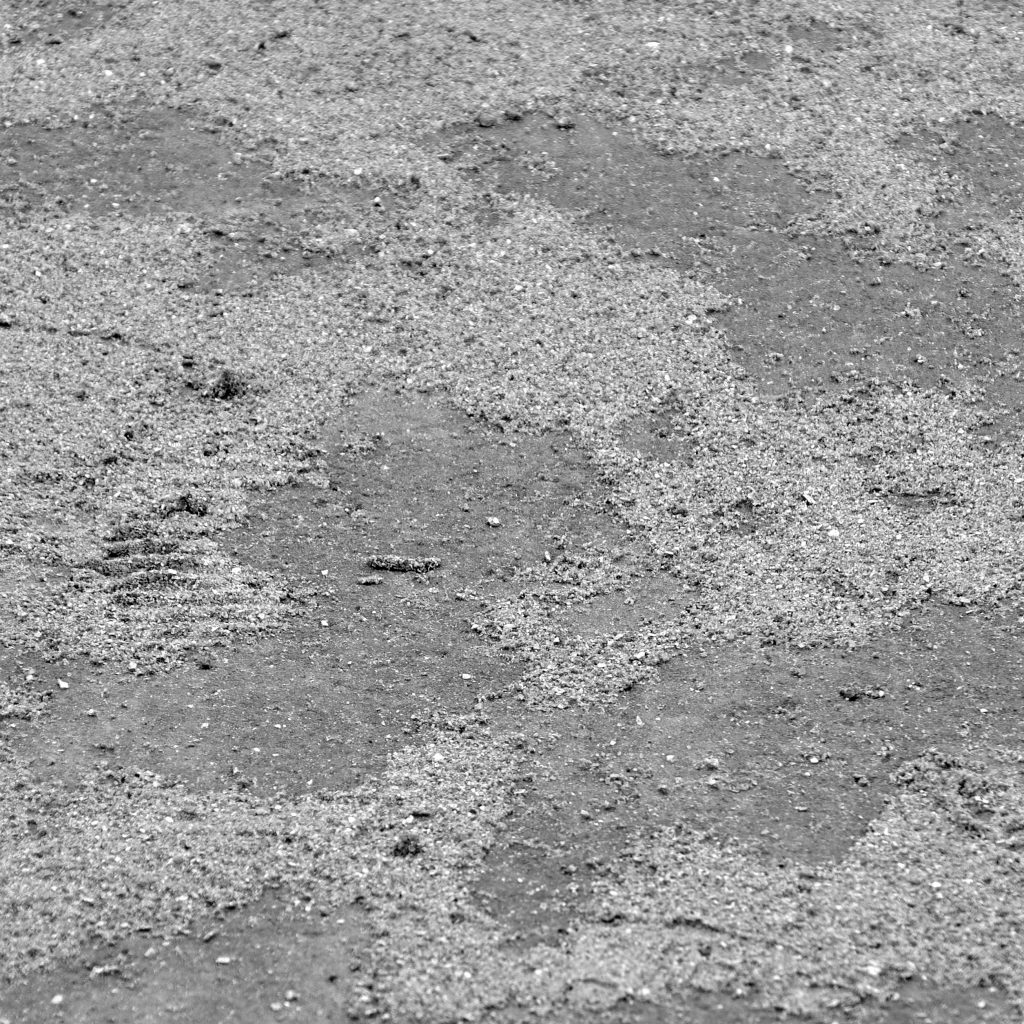
The sand used in the Seville Bullring, or Plaza de Toros de la Real Maestranza de Caballería de Sevilla, plays an important role in the spectacle of bullfighting. The arena’s surface is carefully chosen for both tradition and practicality, affecting the movement of the bull and the matador’s ability to perform.
Typically a mixture of fine, compacted earth, clay, and sometimes chalk. This combination ensures that it provides a stable, firm footing while still allowing for slight shifts in the ground when the bull charges. The specific mix is designed to absorb the impact of hooves, cushion the blows between the bull and the matador, and absorb the blood from the animals. It also creates a visually striking contrast as dust is kicked up during the fight – a visual hallmark of the events, enhancing the dramatic atmosphere.
Maintained by a team of staff, it is regularly swept and sometimes watered to keep it in the right condition. The sand must retain its consistency throughout the event, as any sudden changes could affect both the bull’s behaviour and the matador’s performance. Extra sand is spread to cover the blood after each kill, and the surface overall may be raked and smoothed between fights to ‘reset’ the arena.
In bullfighting culture, the sand represents the brutal, ritualistic nature of the event. It’s not just a practical surface but part of the symbolic landscape of the fight, connecting the spectators to the physicality of the confrontation.
Puerta del Príncipe – The Prince’s Gate
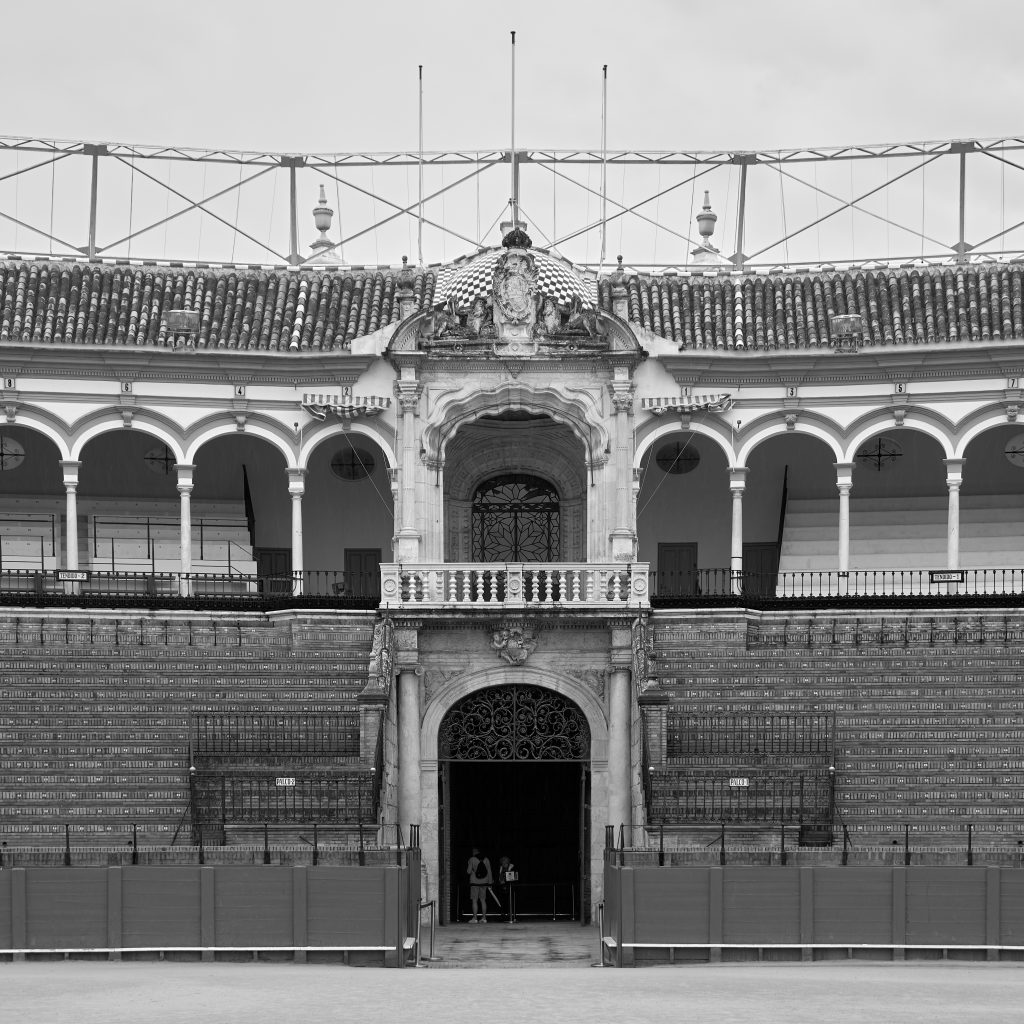
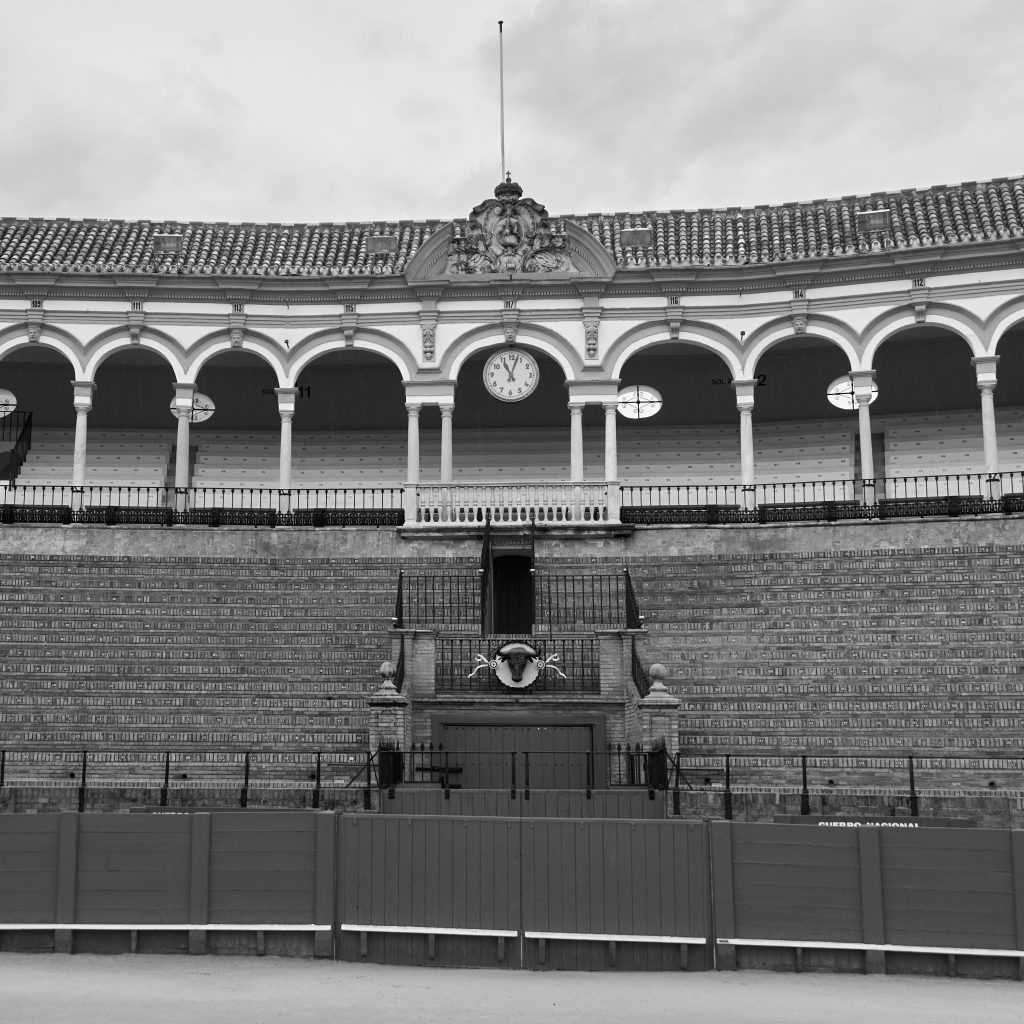
Presenting the main Baroque façade to the river, with doors for the Maestranza nobles and civil authorities, the Prince’s Gate, is about rank, ritual and image. It states who rules the space, and who earns glory inside it.
The inner façade dates from 1765, built for the Bourbon prince Felipe, son of Felipe V. The upper gallery is the Royal Box (Palco del Príncipe), still used by the royal family. The half-dome roof, white and blue tiles, and sculpted group on the top mark it as the visual “crown” of the arena.
The lower part forms the main ceremonial gate into the arena. The Royal box aligns with the long axis of the ring, drawing the eye from almost every seat, and works as a “royal presence” even when no monarch sits there. The famous Puerta del Príncipe is the ritual exit that every matador wants.
The ears and tail are awarded to a matador by the president when urged by the crowd. Since 1982, a matador must earn at least three ears in one afternoon to leave by this gate. To raise the bar for ‘celebrity’ matadors, who fight alone, they must be awarded four ears. Matadors who achieve this leave on the shoulders of their cuadrilla and fans, through that door and out to the Paseo de Cristóbal Colón.
The Vomitoria
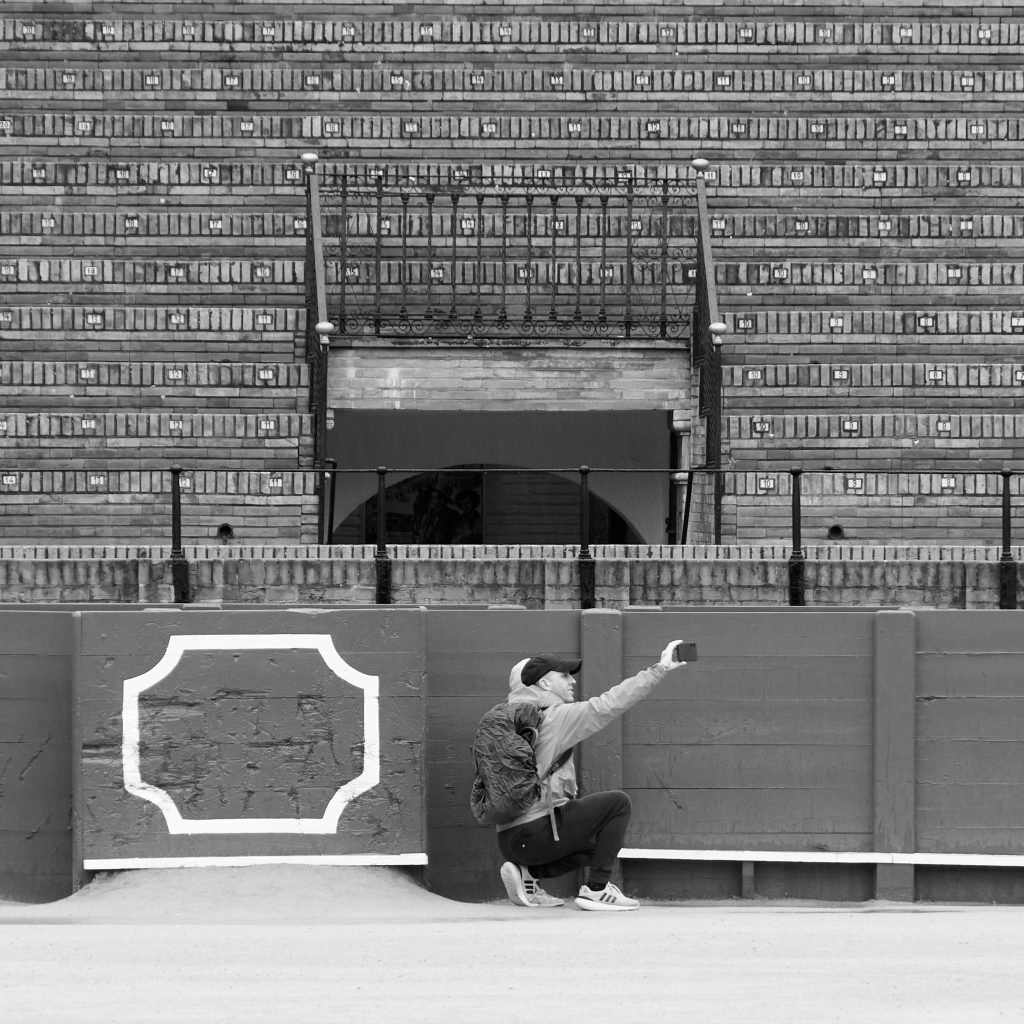
From the street, a set of main doors around the oval façade form numbered, ticketed entrances tied to a specific tendido (section), row and seat. Spectators enter into a covered inner gallery running all round the building, from which staircases and openings feed the seating tiers both above and below.
At the end of the corrida, stewards open the inner gates and the crowd drains down the stairs, through these galleries and out through the same numbered doors. The whole system is built for fast egress. In Roman theatres and amphitheatres, these passages and the flow of people was known as a vomitorium from the Latin vomere, “to spew forth”.
In design terms, their job is clear: to spew out twelve thousand people into the streets of Seville once the killing stops.
Puerta de Toriles – The Entrance of the Bulls
The toriles area sits on the side of the arena that faces the Prince’s gate and Royal box. The corrales, behind this are open pens where lorries unload the herd, and from which staff sort the bulls by ranch, carrying out veterinary checks before the fight. In front of the corrales, and next to the ring wall, are the chiqueros – narrow, dark boxes that hold each bull alone before its turn.
The Puerta de Toriles “por donde sale el toro a la plaza” – the one point where the bull can enter the ring links these chiqueros to the sand. There is a ritual built around this gate. At the start of the event, the alguacilillos on horseback ride to the president’s box to ask for the key. The president hands it down and the rider takes it to the torilero, to open the bull’s gate.
Puerta de Toriles – The Entrance of the Bulls – The Bull’s Eye View
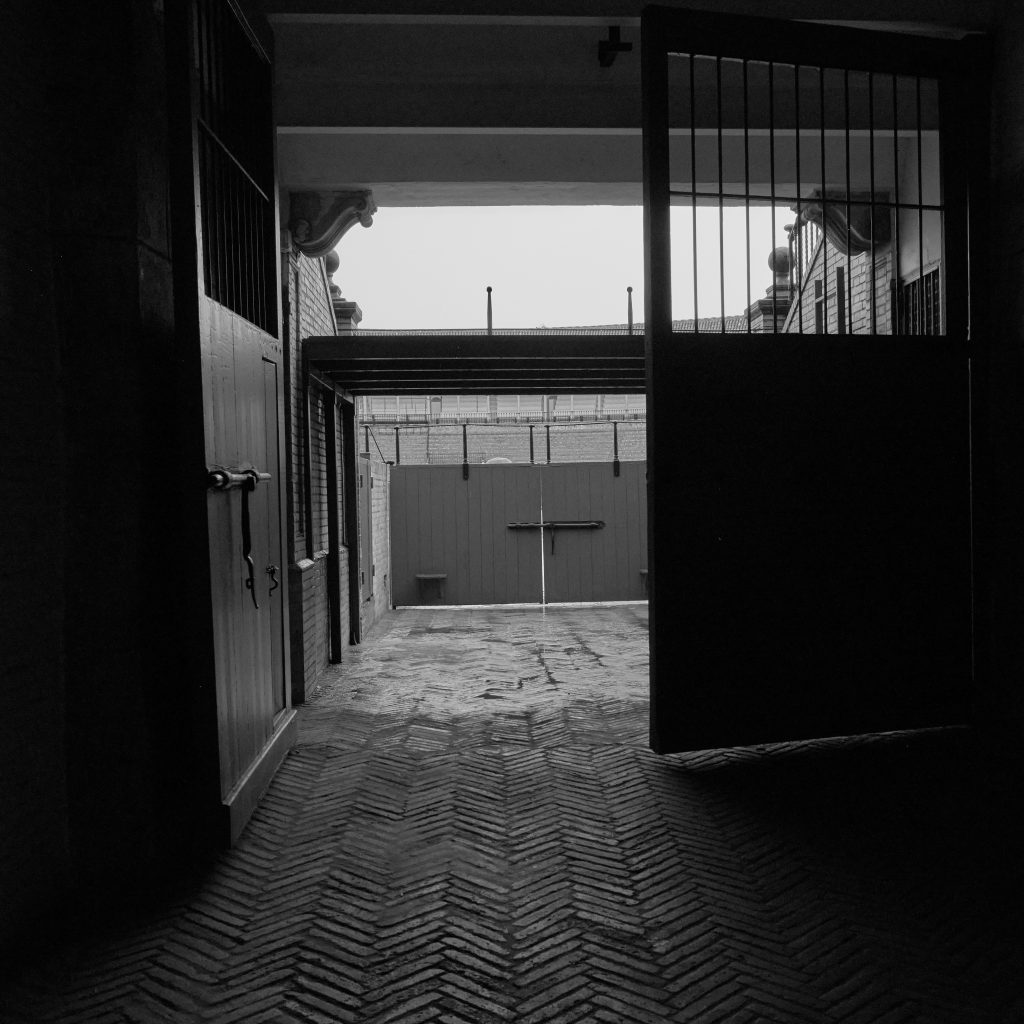
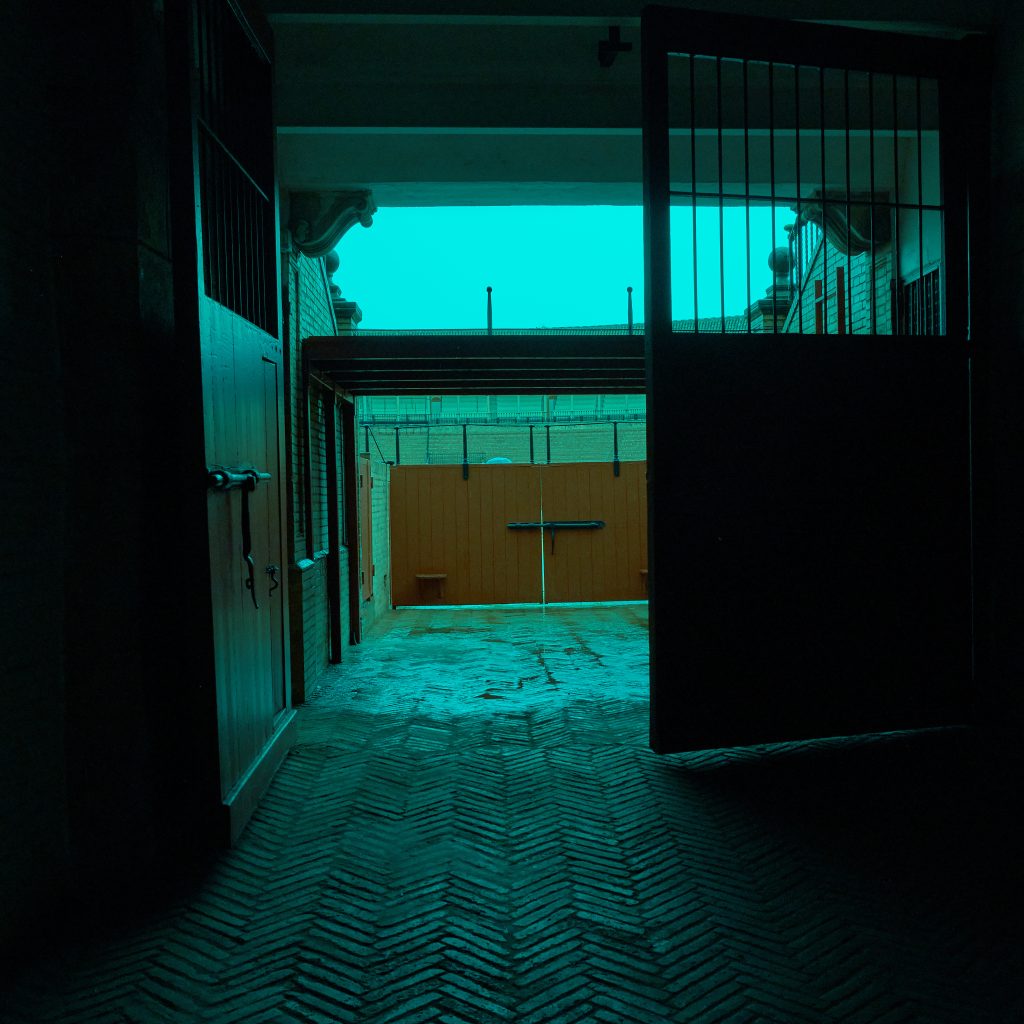
It is a popular myth that bulls are colour-blind. However, bulls don’t see only shades of grey. They see fewer hues than we do, but they do not live in a grey fog.
Cattle have two cone types in the retina. Humans have three. This means that cattle see a blue and green spectrum, but they don’t see red in the way we do. A red cloth looks dark to them. It doesn’t blaze with heat or threat. The myth took hold because matadors move the cloth. The bull tracks the motion; the shade itself has no particular power.
This matters for two reasons. First, it shows how easy it is to frame an act of harm as a trait of the victim. The tale about bulls and red shifts blame. It hides the fact that people bait and break the bull through stress, pain, and fear. Second, it lets us ask how false ideas shape views of farm life and of the rights of non-human beings. If we treat beings as dull, we give cover to abuse.
For the animal, the shift is from a cramped dark box, through the Puerta de Toriles, to blinding light and noise. The whole design funnels that body, and the animal’s fear, to one exact point on the sand, while the crowd and the Royal box look on.
A historic study of the Maestranza notes the “zona de toriles”, with its own balcony of the Diputación set over the toriles gate, forms a clear axis – monarchy at one end, bulls at the other.
Puerta del Despejo – The Clearance Gate
We are told that the death of Victor Barrio in July 2016 was the first death of a matador since that of José Cubero “Yiyo” in 1985. However, matadors are the ‘nobles’ of the ring and there are also deaths (and, of course, injuries) among their team of banderillos and other ‘toreros’. Since modern era bullfighting emerged in 1700, there have been over 500 recorded deaths. In the last decade alone, there have been four reported (Victor Barrio – July 2016, Rodolpho Rodriguez – also in 2016, Iván Fandiño – June 2017, and Manuel Maria Trindade – August 2025). None of these figures and reports address deaths among farm workers outside the ring who are breeding and rearing the fighting bulls for much of the year.
Protection for the matador’s body, has changed little over the years. The traje de luces remains a tight silk suit tailored to show line and grace rather than padding. Some bullfighters wear light protection under the cloth, but culture still rewards a slim, ‘classic’ shape and the idea that the matador shares the bull’s exposure.
Modern rings try to answer the risk this represents with medicine rather than armour. Spanish law now calls for full medical cover inside the plaza. Big city rings market themselves as trauma centres. Pamplona, Madrid, Córdoba and Seville all house on-site infirmaries with operating theatres, teams of surgeons, and clear triage routes from sand to surgery.
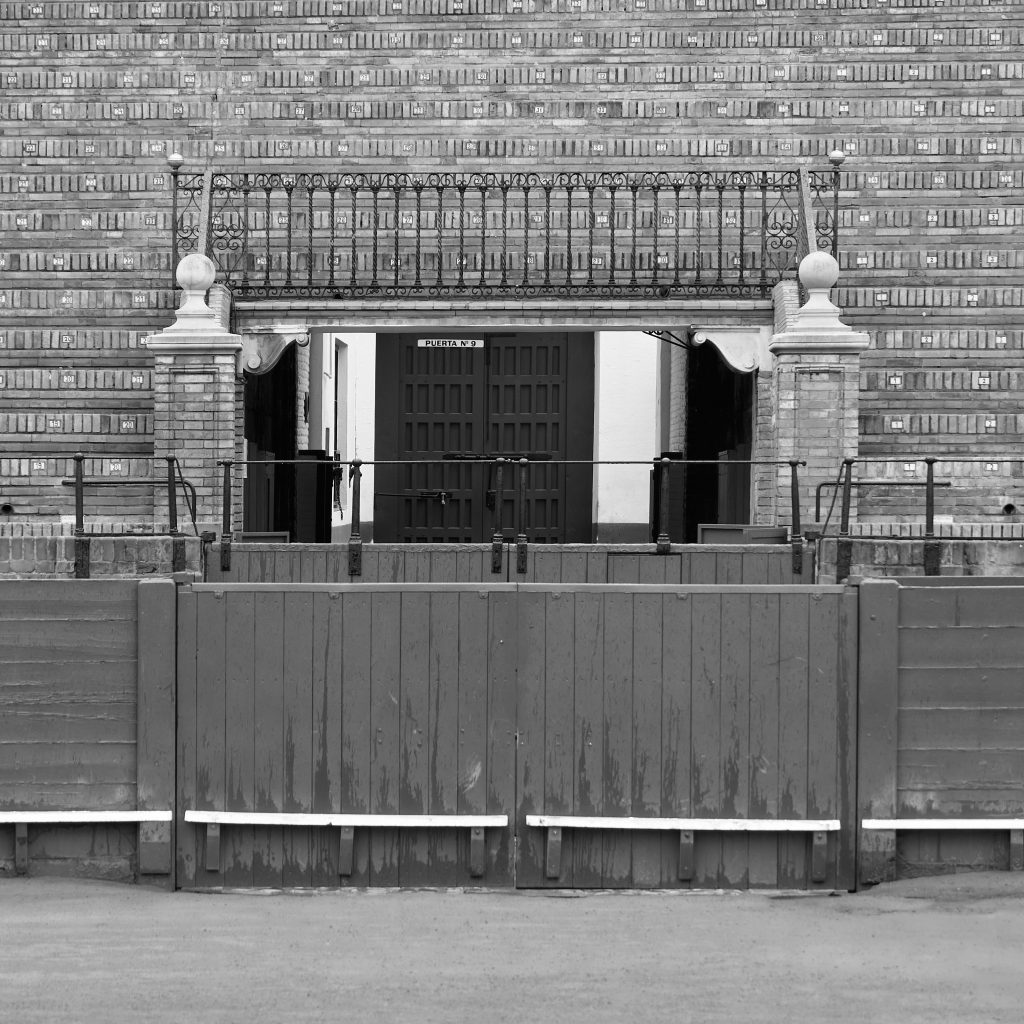
The Puerta del Despejo had previously been used to drag out the bodies of dead horses, but the introduction of protective mantles reduced this need, and the gate was blocked up in the 1950s. However, when the new infirmary was created in the 2000s, it was reopened along with changes to floor levels so that the path from sand to surgery was uninterrupted – its name remains appropriate.
Puerta de Arrastre – the “Dragging Gate”
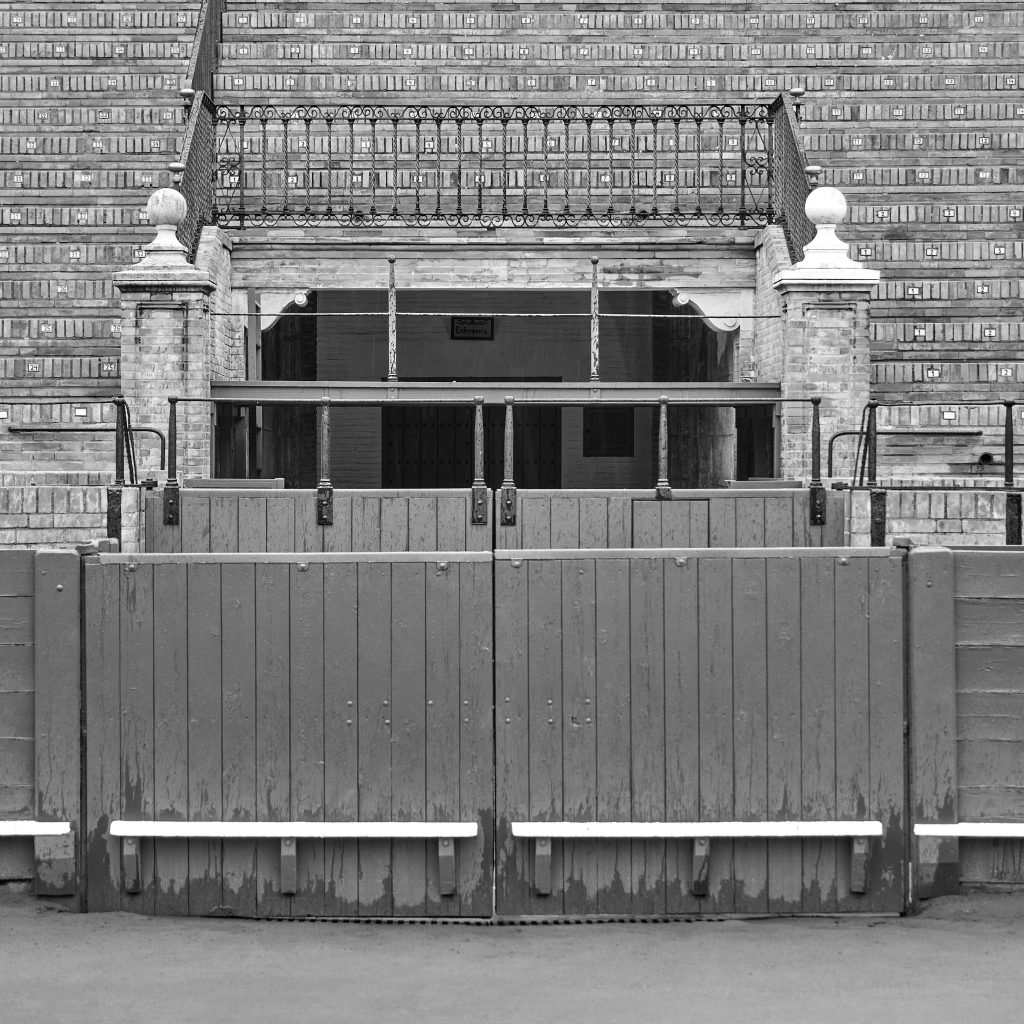
Once the bull lies still, ring staff check that it is dead. The president then calls the arrastre. A team of ‘mules’, the mulillas, come in from the patio through the puerta de arrastre, led by mulilleros in bright dress. They fix chains or a harness to the bull’s horns and set off at a brisk run. Normally, they drag the body in a straight line to the same gate. However, when the president grants a posthumous honour – a vuelta al ruedo – the team drags the bull round the full ring first.
Thus, the dead bull leaves the ruedo through the puerta de arrastre – a low but necessarily wider gate in the barrier that opens from the sand into the patio de arrastre – the service yard that links on to the skinning room and slaughter area – the desolladero. It is in this area that any bull that still shows signs of life is finally slaughtered, skinned and the body bled in hygienic conditions and under veterinary control before it is sent for butchery in refrigerated vans. The rules and processes were ‘tightened up’ in 2001, due to ‘Mad Cow Disease’.
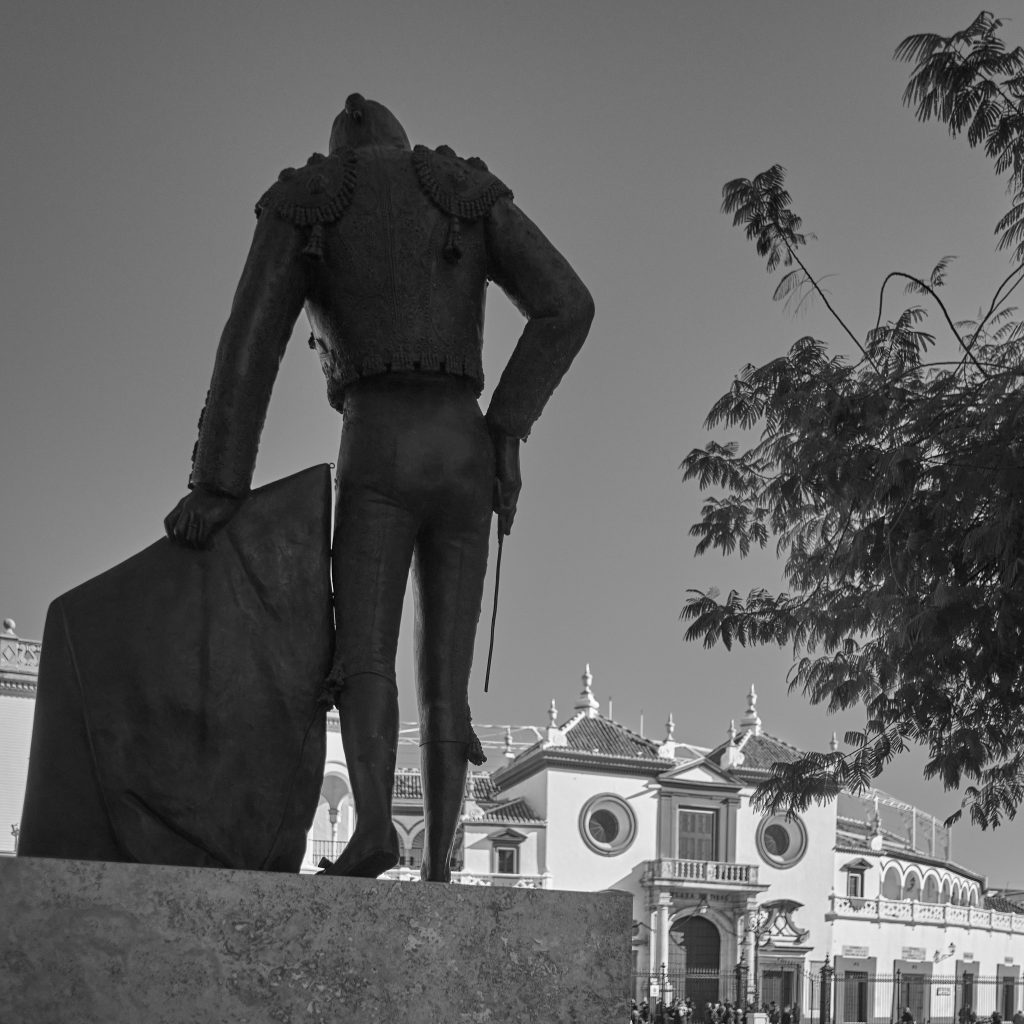
Monument to Manolo Vázquez
Manolo Vázquez was Seville’s house matador. Born in the San Bernardo district in 1929, he took the alternativa in the Maestranza in 1951 and fought more than 300 corridas before his first retirement at 39 years old in 1968. He returned, at 50 in 1981, and said farewell for good in 1983 after a major ‘triumph’ in the same ring. He lived to 75, a long life in a trade marked by blood and shock. His bronze statue, opposite the Maestranza, shows him in a classic, calm pose with the muleta. Estimates vary, but he is thought to have killed between 300 and 500 bulls.
In a classic Spanish corrida, the bull enters the ruedo once and the script says that he must die there. A “fight to the death” is built into the form of the show and into law that still treats this as a set kind of public performance.
A bull that has fought cannot go back to farm life or face the ring again. The much-publicised “pardon” of an outstanding bull, the indulto, is a very rare exception that saves only a handful of animals each year and exists to feed breeding lines, not to soften the death rate.
The idea that rings sit on the edge of town so that loose bulls pose less risk is folk talk more than fact. Some old plazas did start at the fringe, but many, like Seville or Pamplona, now lie in dense city streets. A fighting bull that breaks out is very dangerous, as the death toll at street runs shows, yet the rule that the bull does not leave the ring alive comes from the needs of the show and the meat trade, not from a wish to protect the town.
In a standard corrida, three matadors face six adult bulls and all six are killed. At Seville, the 2024 and 2025 seasons listed 24 events each year – 16 or 17 full corridas plus a horse show and six novice fights – which means in the region of 140 to 150 bulls killed per season in this ring alone.
Across Spain as a whole, animal rights groups now speak of at least 7,000 bulls killed in official rings per year, and “tens of thousands” if one adds town fiestas and linked events.
Earlier in the month, I posted details of the first ‘pilot’ of my project “Sentient Souls”. The first set of images were of abused animals presented as photographers. Project: Sentient Souls – The Photographers – Utopia
Having bounced this off a couple of trusted individuals, I went ahead and produced a range of these studies: In the Library, The Artist, The Gourmand, The Hunter, The Singer, and The Laboratory. Along with an expanded set of notes, they are now available as a catalogue on Amazon: https://amzn.to/3ZTVBmj
The Singer is the only set based around one species. Chickens have a repertoire of more than 24 calls used to communicate with one another. It seemed appropriate to give them a project of their own based on different forms of song…
After the book was produced, I was asked why I hadn’t included any turkeys. A very fair question. This led to a single image accompanied by a short story in the style of Orwell’s Animal Farm: Pilgrim’s Tale – A Christmas (and Thanksgiving) Carol – Utopia. However, in producing this image there a few alternatives that just didn’t hit the mark for me. One of these is the featured image above.
Pilgrim the Turkey was not like the others on the farm. When the Great Culling came, he hid in the brambles, his trembling feathers camouflaged by the thick, thorny undergrowth. From his hiding spot, he witnessed the farmer and his helpers dragging away his kin, their plaintive cries echoing in the crisp winter air. The slaughterhouse smoke rose thick and black on the horizon, marking the end of his flock and the beginning of his solitude.
For days, Pilgrim wandered the now-silent fields, avoiding the barn where the scent of his lost companions lingered. The sheep bleated their usual ignorance, and the pigs, fat and self-satisfied, paid him no mind. Yet the hens whispered of his survival, calling him the “Last Feather,” a ghost of a bird who had outwitted the inevitable. Pilgrim, however, did not feel like a hero. He felt like a coward.
One evening, as the setting sun cast long shadows over the farm, Pilgrim perched on the roof of the empty coop, gazing at the distant slaughterhouse. The sight of it filled him with both dread and resolve. “They will come again,” he muttered to himself. “And when they do, there must be turkeys to meet them.”
Pilgrim’s mission began the next day. He scratched the earth with purpose, gathering worms and seeds to regain his strength. Slowly, he coaxed the hens to lend him their eggs. “It is not for me,” he assured them, his voice low and solemn. “It is for the future of the flock.”
The pigs sneered when they heard of Pilgrim’s efforts. Napoleon, the largest and greediest, waddled up to him one morning. “Why bother?” he scoffed, his snout dripping with slop. “Turkeys are good for one thing, and it isn’t living.”
Pilgrim met the pig’s gaze, his beady eyes shining with defiance. “Perhaps,” he said, “but even a harvest must have seeds.”
Months passed, and Pilgrim’s small flock began to grow. He taught the young poults how to forage, how to hide, and how to recognise the farmer’s heavy boots. He warned them of the traps laid not in the woods but in their own minds—the complacency that had doomed their predecessors. “Survival,” he told them, “is an act of rebellion.”
But as spring turned to summer, whispers began to circulate. The hens clucked nervously, and the sheep’s bleating took on a note of panic. The farmer had ordered new crates, sturdier and larger than before. Pilgrim watched as the pigs feigned ignorance, their bellies swelling with stolen corn.
When the boots came again, Pilgrim’s flock stood ready. But to his horror, many of the young turkeys, emboldened by their training, marched willingly toward the farmer. “We will show them we are strong,” they said. Pilgrim called after them, his voice cracking with desperation. “Strength is not in sacrifice! Strength is in survival!”
As the slaughterhouse smoke rose once more, Pilgrim perched on the hill, his feathers heavy with failure. Yet even then, he resolved to try again. For what else could a turkey do but persist?
Turkeys as Sentient Souls: Turkeys are sentient beings capable of experiencing a range of emotions and exhibiting complex social behaviours. They form strong social bonds, display affection, and engage in communal activities. For instance, turkeys have been observed holding “great wakes” over fallen companions, indicating a capacity for empathy and mourning.
In natural settings, turkeys can live up to 10 years, during which they develop intricate social structures within their flocks. They express emotions such as happiness and fear, and have been known to protect their young and groom each other, showcasing their affectionate nature.
These behaviours suggest that turkeys are not mere automatons but sentient creatures with the ability to perceive and experience the world around them. Recognizing their sentience is crucial for understanding their needs and ensuring their well-being.
The Twice Annual “Great Culling”: Each year, approximately 620 million turkeys are slaughtered worldwide for meat. In the United Kingdom, around 9 million turkeys are killed annually for human consumption. In the United States, about 250 million turkeys are slaughtered each year.
Animal Farm: In Animal Farm by George Orwell, there is no mention of turkeys. The animals on the farm primarily include pigs, horses, dogs, sheep, hens, cows, and birds like pigeons. Each of these animals serves an allegorical purpose tied to Orwell’s critique of Soviet communism and human nature.
Pilgrim: A nod to Thanksgiving and the turkey’s association with sacrifice, linking it to ideas of displacement and marginalisation.
Symbolic role: A Gullible Idealist. Turkeys are often associated with being naïve or foolish in popular culture. Orwell could have used the turkey to show how well-meaning but less critical individuals were duped into supporting the revolution, only to face betrayal or elimination.
New methods, such as electroencephalography (EEG), positron-emission tomography (PET-scanning), magneto-encephalography (MEG), and frequency-modulated magnetic resonance imaging (fMRI), have led to a substantial revision of our understanding of the meaning and consequences of ‘sentience’.
Sentience goes beyond merely having feelings. A sentient being is one that has some ability to evaluate the actions of others in relation to itself and third parties, it can remember some of its own actions and their consequences, assess risks and benefits. The concept of sentience has parallels with ideas of the soul or psyche that have often been used to propose that humans are fundamentally different from other animals. Current research on the components of sentience shows that humans share cognitive and emotional abilities with many other animals.
The Animal Welfare (Sentience) Act 2022 recognises animal sentience in law for the first time. The scope of the legislation includes all vertebrates and some invertebrates such as octopuses and lobsters.
The Project
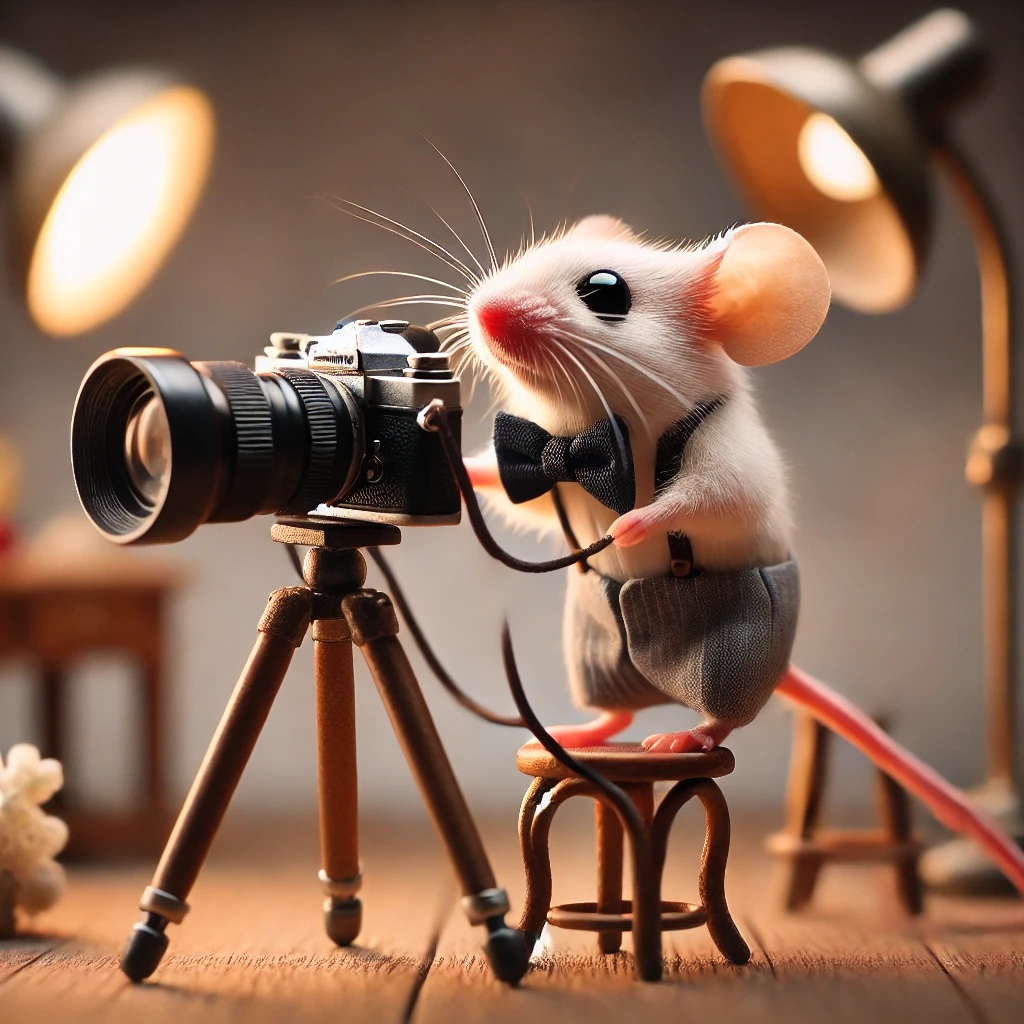
A series of images of animals known to be sentient, that are routinely farmed, used for experiments, or otherwise abused in the UK. The images try to illustrate the intelligence of the animals – in this series, demonstrating their skills as photographers. The images are to be produced as greeting cards and larger prints for sale.
[metaslider id=”1592″]
Goats
Goats in the dairy industry often suffer from overmilking, leading to mastitis, and unwanted kids are frequently culled. Data on goat slaughter in the UK is limited. However, the number is significantly lower than for cattle or sheep, likely in the tens of thousands annually.
Male calves
In the dairy industry, male calves are often considered a by-product. While specific UK figures are scarce, in October 2024, 204 thousand steers, heifers, and young bulls were slaughtered. Many will have been raised in confined spaces with restricted movement.
Male chicks
In the egg industry, male chicks are culled shortly after hatching. Approximately 29 million male chicks are killed each year in the UK, often by maceration or gassing, as they do not lay eggs and are unsuitable for meat production.
Chickens
Every WEEK, we slaughter 22 MILLION chickens in the UK, the vast majority are for humans to eat. A small proportion are chickens that have been used for egg ‘production’ and that no longer meet their targets!
Mice
In 2022, over 2 million mice were used in scientific procedures in the UK. Mice in laboratories are often subject to painful experiments, kept in small cages, and generally ‘euthanised’ after testing. Their use is ‘justified’ because of practicality, their genetic and immune system similarities to humans, short lifespan and high rate of reproduction. Advances in technology, such as organ-on-a-chip models and computational simulations, slowly offer alternatives to using animal ‘models’ in research.
Pigs
Pigs endure overcrowding, tail docking without anaesthesia, and are often kept in barren, confined spaces. Sows are confined to farrowing crates, unable to move freely. The UK slaughters millions of pigs annually for meat. In October 2024 alone, about 966,000 clean pigs were slaughtered.
Salmon
The UK is a major producer of farmed salmon. While exact numbers are not readily available, it’s estimated that tens of millions are harvested annually. Farmed salmon live in crowded pens, suffer from diseases and parasites, and endure stressful slaughter methods such as suffocation or being clubbed.
Sheep
Sheep are subjected to painful procedures such as mulesing without pain relief, shearing injuries, and live export journeys under harsh conditions. The UK slaughters millions of sheep each year. In October 2024, approximately 1,088,000 clean sheep were slaughtered.
Criticisms of this approach – particularly from within the Animal Rights activist community
1. Trivializing the Issue
Some activists may feel that using humour to highlight the intelligence of sentient animals risks trivializing their suffering. By presenting the issue in a light-hearted way, the severity of the abuse and exploitation might be overshadowed or diluted.
2. Anthropomorphism Concerns
Critics could argue that portraying animals in human roles, such as scholars, scientists, or photographers, reinforces an anthropocentric perspective. This might unintentionally suggest that animals deserve moral consideration only if they exhibit traits that align with human definitions of intelligence.
3. Potential for Misinterpretation
The humour might be misinterpreted by some viewers as purely entertaining rather than carrying a serious message. This could lead to the message being overlooked or dismissed, reducing the campaign’s effectiveness.
4. Exclusion of Emotional and Ethical Dimensions
By focusing on intelligence, the campaign may exclude other important reasons to respect animals, such as their capacity to feel pain, form bonds, and experience joy and suffering. Activists may argue that intelligence shouldn’t be a prerequisite for ethical treatment.
5. Overlooking Broader Systemic Issues
Some activists might view this approach as too individualized and disconnected from systemic critiques of animal exploitation industries. They might argue that it doesn’t address larger issues like capitalism, environmental degradation, and speciesism, which perpetuate abuse.
6. Appealing to the Wrong Audience
If the target audience is indifferent or resistant to animal rights, the humour could backfire, making the subject seem less serious or giving the impression that activists are not deeply committed to their cause.
7. Reinforcement of Consumerism
By presenting polished, professional, and humorous content, some might argue this approach risks mimicking advertising aesthetics, potentially aligning with the very consumerist mindset that perpetuates animal exploitation.
8. Missing an Opportunity for Emotional Connection
Activists may argue that appeals to empathy and emotional connections, such as showing animals in natural behaviours or highlighting their suffering directly, can be more impactful and transformative for audiences than humour.
The rationale for the project
The goal is not to diminish the gravity of animal suffering but to create an alternative way of engaging people who might otherwise remain indifferent.
1. Engaging a Wider Audience
Humour can serve as an effective icebreaker, drawing in individuals who might otherwise resist or avoid animal rights discussions. It creates an approachable entry point for a topic that many find uncomfortable or overwhelming.
By appealing to a broader audience, this approach can reach beyond the “converted” and engage those less familiar with animal rights issues.
2. Reducing Psychological Defensiveness
A humorous tone can lower emotional barriers and defensiveness, making people more receptive to new ideas. When people feel less attacked or guilty, they are more likely to consider alternative perspectives.
The subtlety in the messaging avoids the confrontational tone that some may associate with animal rights activism, fostering curiosity rather than resistance.
3. Encouraging Reflection Through Satire
Humour and satire can be powerful tools for encouraging self-reflection. By depicting animals in intelligent or creative roles, the absurdity of their exploitation is highlighted, prompting viewers to question the moral inconsistencies in their treatment of animals.
4. Showcasing Animals’ Unique Qualities
By humorously portraying animals in intelligent or unexpected roles, this approach invites viewers to think about animals in ways they might not have before, breaking stereotypes and expanding empathy.
It emphasizes the idea that animals have intrinsic worth and abilities, shifting the narrative from seeing them solely as commodities.
5. Creating Memorable and Shareable Content
Humour tends to be more memorable and shareable, especially in the age of social media. Images or campaigns that make people smile or laugh are more likely to be circulated, spreading the message to a larger audience.
This virality can amplify awareness and bring the issue into mainstream conversations in a non-confrontational way.
6. Opening Doors for Deeper Conversations
Humour can act as a gateway for deeper, more serious discussions. After engaging with lighthearted content, individuals may be more open to learning about the ethical, environmental, or health issues related to animal exploitation.
7. Demonstrating Compassion in Activism
A humorous approach reflects the creativity, compassion, and humanity of the activist, countering stereotypes of animal rights activists as overly angry or judgmental. This can help build bridges with skeptics or critics.
8. Highlighting the Absurdity of Exploitation
By humorously juxtaposing animals’ intelligence with their treatment in society, this approach subtly underscores the moral contradiction in exploiting sentient beings capable of thought and emotion.
9. Cultural Relevance
In a culture where entertainment dominates attention spans, this approach aligns with current trends, making animal rights advocacy more culturally relevant and relatable.
10. Complementing Other Approaches
This method can complement more direct and emotionally charged campaigns. Together, they provide a diverse toolkit for reaching different audiences and addressing various dimensions of the issue.
If you have one day to take photographs that concern animal welfare, you can focus on capturing images that evoke empathy, awareness, and understanding of the challenges and positive aspects related to animal welfare. Here are some potential subjects and themes you could consider photographing:
Animal Shelters and Rescues:
Visit local animal shelters and rescues to document the efforts made to care for and rehome animals. Capture images of volunteers, staff, and the animals themselves. Highlight the positive aspects of adoption and the challenges faced by animals waiting for homes.
Pet Adoption Events:
Attend pet adoption events and document the interactions between potential adopters and animals. Capture moments of joy and connection as families consider adopting a new pet.
Animal Sanctuaries:
Explore animal sanctuaries that provide refuge for animals rescued from various situations, such as factory farms, laboratories, or abusive conditions. Showcase the animals living freely and the caretakers dedicated to their well-being.
Farm Animal Advocacy:
Document the conditions of farm animals in different settings. Visit local farms with humane practices and photograph animals in natural environments. Alternatively, explore the challenges faced by animals in industrial farming operations, highlighting the need for improved welfare standards.
Wildlife Rehabilitation Centers:
Visit wildlife rehabilitation centers and photograph the efforts to care for injured or orphaned wild animals. Highlight the work of veterinarians, rehabilitators, and volunteers in providing medical care and fostering the eventual release of wildlife back into their natural habitats.
Community Animal Welfare Initiatives:
Document local initiatives and community programs focused on animal welfare. This could include low-cost veterinary clinics, spaying/neutering programs, or educational workshops on responsible pet ownership.
Animal Rights Events and Protests:
Attend animal rights events or peaceful protests to document the advocacy work being done to raise awareness about animal welfare issues. Capture the emotions and dedication of activists striving for positive change.
Human-Animal Bonds:
Showcase the positive relationships between humans and animals. Photograph therapy animals providing comfort, assistance animals aiding individuals with disabilities, and the healing connections between animals and people.
Environmental Impact on Wildlife:
Explore and document the impact of human activities on wildlife habitats. Show the consequences of deforestation, pollution, or climate change on animals in their natural environments.
Positive Stories of Rehabilitation:
Share success stories of animals that have overcome adversity through rehabilitation efforts. Photograph animals that have been rescued and nursed back to health, emphasizing their resilience.
Remember to prioritize the well-being of the animals during your photography. Be respectful of their space, avoid causing stress, and, if necessary, seek permission from relevant authorities before photographing animals in certain locations. Through your images, aim to convey a powerful message about the importance of compassion, responsible stewardship, and the need for positive change in the realm of animal welfare.