From the Amazon rubric: “The Psychology of Place – A Guide to Psychogeography for Photographers explores how urban environments shape perception, emotion, and behaviour, and how photography can investigate these relationships. Drawing on Guy Debord and the Situationist International, it introduces psychogeography as a way to understand the emotional contours of cities through exploratory wandering. The book weaves in later insights from sociology, geography, and photographic practice to build a practical, reflective framework for contemporary image‑making.
It argues that the city is not a neutral backdrop but an active force influencing how people feel and act. Streets, buildings, infrastructure, and public spaces guide movement, attention, and social interaction. Referencing thinkers such as Henri Lefebvre and Pierre Bourdieu, the text shows how power, social relations, and cultural histories become embedded in space, giving urban environments layers of meaning beyond their physical form.
A central method is the dérive, or drift, in which individuals move through the city guided by curiosity rather than purpose. This mode of walking disrupts habitual routes and reveals overlooked spaces, transitions between districts, and subtle shifts in atmosphere. It encourages heightened attention to light, sound, texture, and spatial arrangement. Through repeated exploration, patterns emerge in how environments shape emotional responses.
Photography functions as both observation and interpretation. The camera records fragments of urban experience, from architectural details to traces of daily life. Psychogeographic photography has no fixed style: some images follow documentary clarity, while others use reflections, layering, or weather to evoke sensory experience. What matters is the relationship between image and place rather than adherence to aesthetic conventions.
The book also examines how photographers construct meaning through selection, framing, and sequencing. Individual images rarely stand alone; sequences reveal movement, changing atmospheres, and contrasts across the city. Photography thus becomes a form of inquiry into urban structure and experience.
Ethical and political concerns run throughout. Urban spaces reflect inequalities of wealth, access, and power, and photographic representation shapes how these spaces are understood. The book encourages reflexivity, asking photographers to consider how their background influences what they see and how they depict it. Issues such as surveillance, public space, and responsibilities toward communities are addressed.
Across its chapters, the text moves from theory to practice. It explores how perception is shaped by social experience, how urban form influences behaviour, and how walking can serve as research. It then develops photographic strategies for documenting and interpreting place, including mapping, sequencing, and reflective practice.
The final sections emphasise psychogeography as an ongoing process rather than a fixed method. Cities change continually, and repeated exploration reveals new relationships between environment, memory, and experience. Photography becomes part of this evolving engagement, offering a way to record and reflect on encounters with the urban world.
Overall, the book positions psychogeographic photography as both a way of seeing and a way of thinking. It invites photographers to move beyond surface description and engage critically with the spaces they inhabit, allowing the city to emerge as a dynamic field of meaning shaped by structure and lived experience.”
Copies in all three formats – hardback, paperback, and ebook – can be obtained from Amazon – https://amzn.to/4vimtdw
I needed to clear the staircase, so I thought I’d see which photography books have settled there in the last couple of months.
James Redbanks (2016) The Shepherd’s View – Modern photographs from an ancient landscape.
As inspiration/research for a long-term project that I’m currently doing on a wool farmer and his work.
Janine Wiedel (2025) Life at the Fence – Greenham Common Women’s Peace Camp 1983/84
As inspiration/research for another long-term project, recently started, on the current nuclear threat, impending 2nd cold war, and the ritual dance between peace camps and nuclear facilities.
Simon Martin & Marco Livingstone (2008) Colin Self – Art in the Nuclear Age
For the same reasons as above. I saw some of Self’s work at an exhibition in Bath earlier this year and I was curious about more artistic applications of photography to support my project.
Sarah Meister (2013) Bill Brandt – Shadow and Light
I took a course by Sarah a few years ago, and was inspired by the depth to which she considered individual bodies of work, and Bill Brandt has always fascinated me, so when I saw that she had curated an exhibition of his work at MoMA NY, I was keen to get the accompanying book. So glad that I did.
Colin Westerbeck & Joel Meyerowitz (2017) Bystander – A history of Street Photography
It is on my stairs because I was double checking something before responding to a comment on a forum.
Adam Broomberg (2021) Glitter in my wounds
I recently attended a lecture by Broomberg, who was professor of photography in Berlin and currently teaches an MA in the Hague. Currently, he has to be the most consistently daring, long-term project, activist photographer who literally puts his life on the line for the sake of his cause. This book is a relatively straightforward exploration of the experience of trans-people. It was the only one of his books that I could afford! His recent work (“Anchor in the Landscape”) on the Israeli settlers destruction of 1000+yr old olive trees in Palestine is awe inspiring.
George Steinmetz (2024) Feed the planet – a photographic journey to the world’s food.
I met Steinmetz at the Visa Pour l’Image-Perpignan this year. His exceptionally long-term project on the world’s agriculture, from an environmental perspective, is a perfect illustration of how a photographer these days has to truly understand their subject matter.
No idea whether this will interest anyone, but it was a useful exercise looking at them again, albeit briefly.
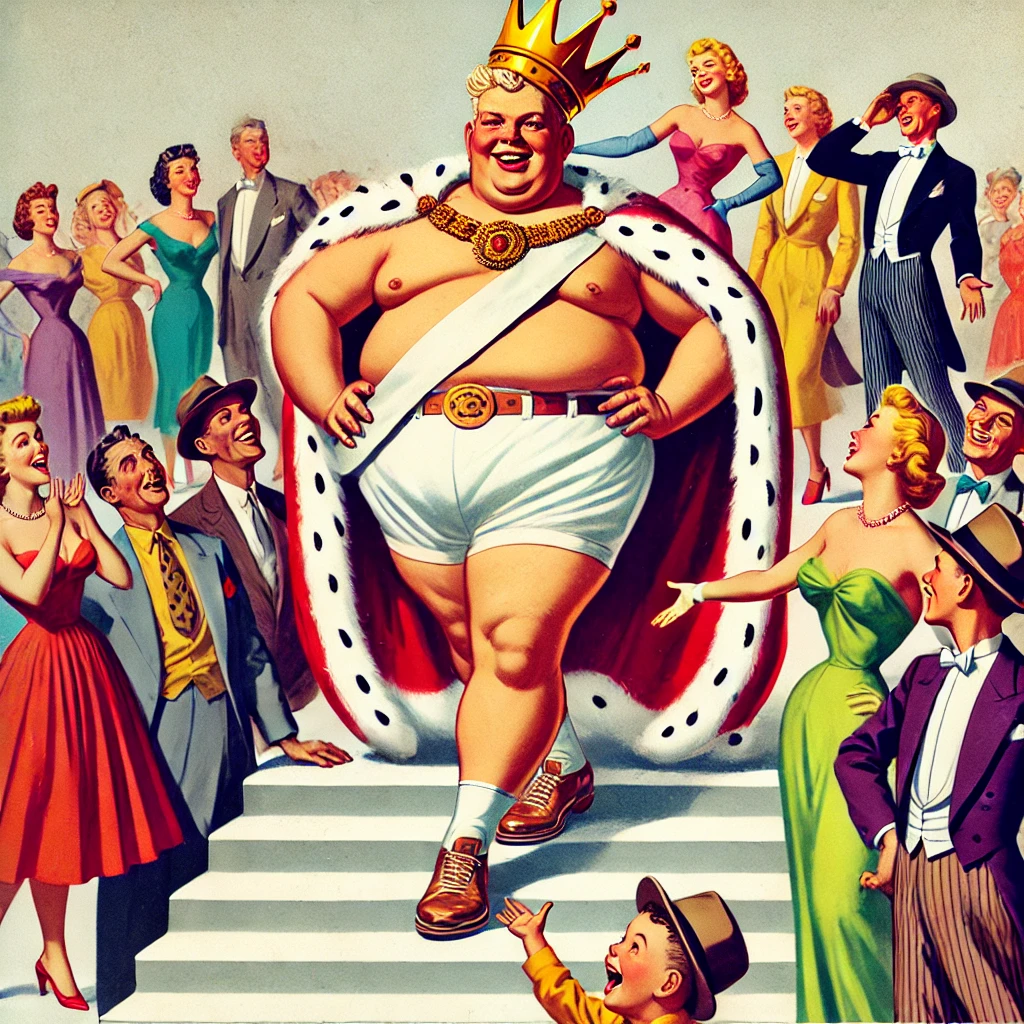
There was once a president who loved crowds more than policy. He filled his days with rallies and long speeches about himself. What he feared most was being seen as weak.
Two slick advisers came to him. They said they could make a suit so fine that only true patriots could see it. Anyone who doubted would show themselves to be un-American. This pleased the president. He thought: Now I will know who is loyal and who is not.
The advisers set up their stage. They had no cloth at all. They waved their arms and said, “Look at this fabric. It shines like gold. It is stitched with freedom itself.” The president saw nothing, but he dared not say so. He thought, If I cannot see it, others will call me a traitor.
His aides and party leaders came in. None of them could see a thing, but all cried out, “Magnificent!” They feared being cast out as weak or disloyal.
At last the day of the parade came. The president strode out, waving to the crowd in his new suit. The networks filmed him, and the commentators said how strong he looked. But the people, standing in the heat, saw only a man in his underwear.
A child, sitting on her parent’s shoulders, shouted, “He has nothing on!” The crowd fell silent. Then more voices took up the cry. Soon the square was full of laughter and anger mixed together.
The president flushed, but walked on, chin high, for he thought: If I keep marching, perhaps they will believe the lie after all.
An account of the entrances and exits of both humans and bulls
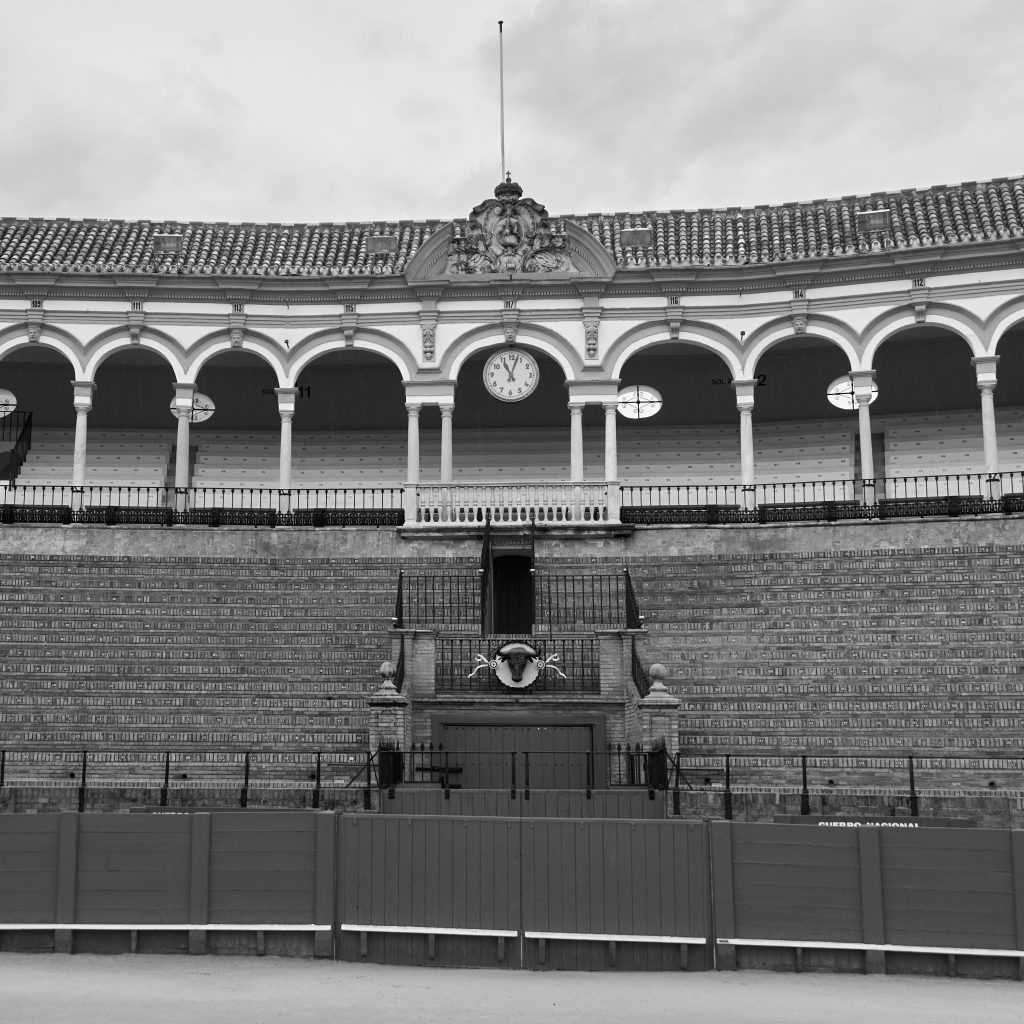
El Ruedo
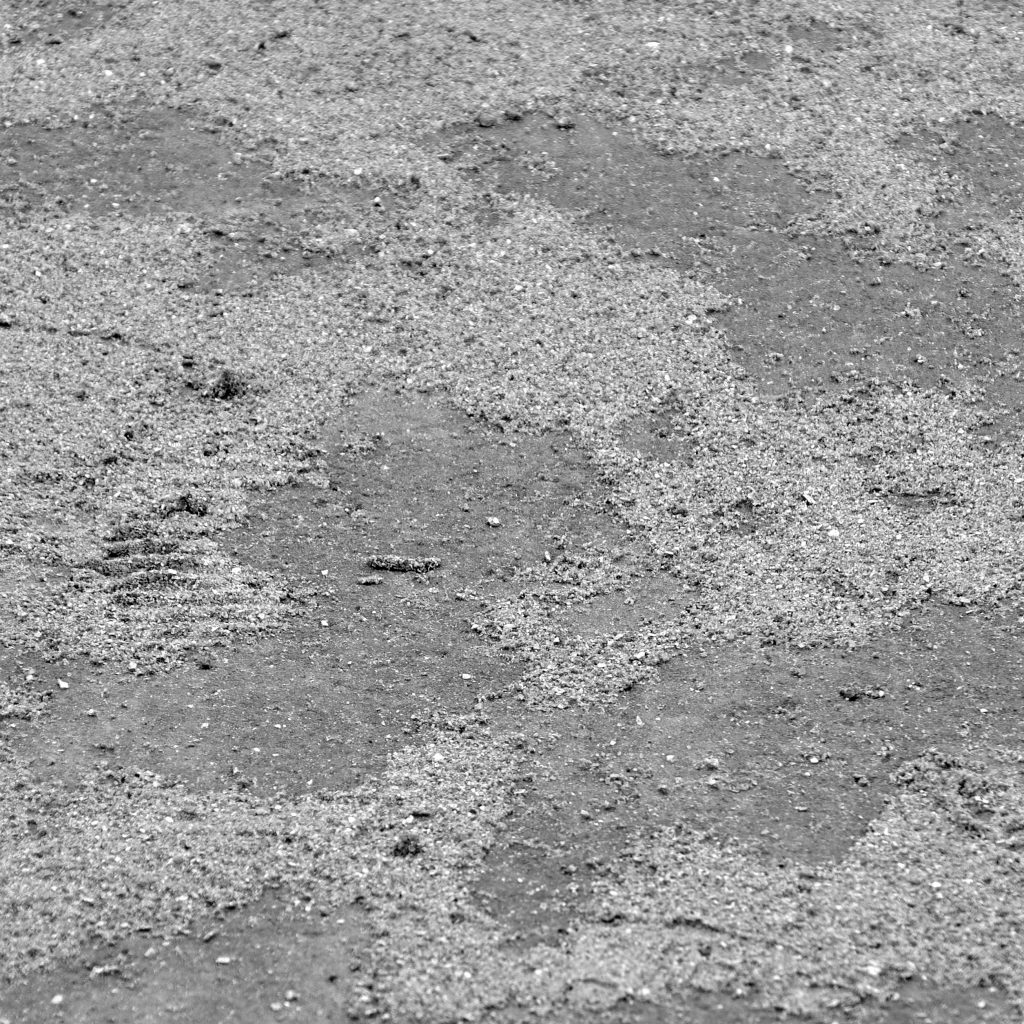
In everyday English people just say “the arena”, but in Spanish bullfighting language ruedo is the proper term for the circular performance space where the bull and bullfighter meet, as distinct from the surrounding tendidos (seating), barrera (barrier) and so on.
The sand used in the Seville Bullring, or Plaza de Toros de la Real Maestranza de Caballería de Sevilla, plays an important role in the spectacle of bullfighting. The arena’s surface is carefully chosen for both tradition and practicality, affecting the movement of the bull and the matador’s ability to perform.
Typically a mixture of fine, compacted earth, clay, and sometimes chalk. This combination ensures that it provides a stable, firm footing while still allowing for slight shifts in the ground when the bull charges. The specific mix is designed to absorb the impact of hooves, cushion the blows between the bull and the matador, and absorb the blood from the animals. It also creates a visually striking contrast as dust is kicked up during the fight – a visual hallmark of the events, enhancing the dramatic atmosphere.
Maintained by a team of staff, it is regularly swept and sometimes watered to keep it in the right condition. The sand must retain its consistency throughout the event, as any sudden changes could affect both the bull’s behaviour and the matador’s performance. Extra sand is spread to cover the blood after each kill, and the surface overall may be raked and smoothed between fights to ‘reset’ the arena.
In bullfighting culture, the sand represents the brutal, ritualistic nature of the event. It’s not just a practical surface but part of the symbolic landscape of the fight, connecting the spectators to the physicality of the confrontation.
Puerta del Príncipe – The Prince’s Gate
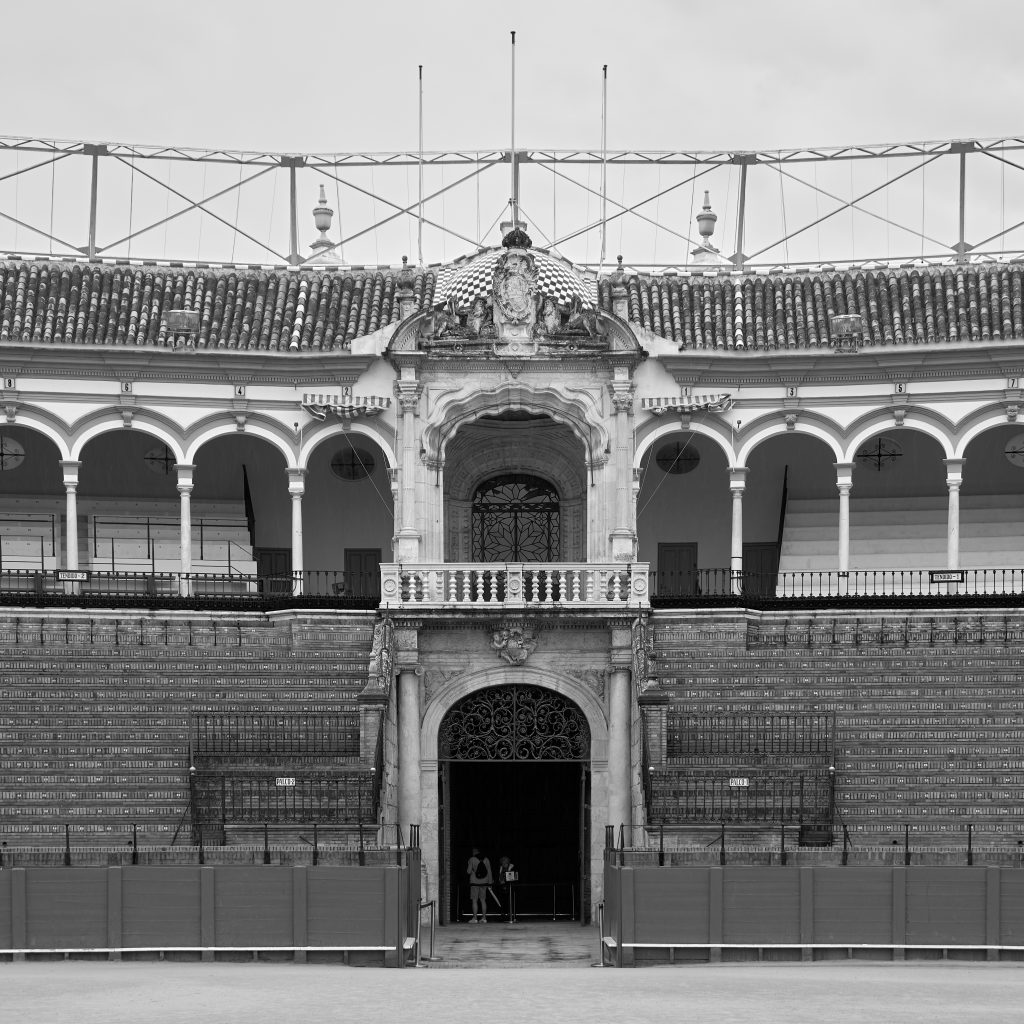
Presenting the main Baroque façade to the river, with doors for the Maestranza nobles and civil authorities, the Prince’s Gate, is about rank, ritual and image. It states who rules the space, and who earns glory inside it.
The inner façade dates from 1765, built for the Bourbon prince Felipe, son of Felipe V. The upper gallery is the Royal Box (Palco del Príncipe), still used by the royal family. The half-dome roof, white and blue tiles, and sculpted group on the top mark it as the visual “crown” of the arena.
The lower part forms the main ceremonial gate into the arena. The Royal box aligns with the long axis of the ring, drawing the eye from almost every seat, and works as a “royal presence” even when no monarch sits there. The famous Puerta del Príncipe is the ritual exit that every matador wants.
The ears and tail are awarded to a matador by the president when urged by the crowd. Since 1982, a matador must earn at least three ears in one afternoon to leave by this gate. To raise the bar for ‘celebrity’ matadors, who fight alone, they must be awarded four ears. Matadors who achieve this leave on the shoulders of their cuadrilla and fans, through that door and out to the Paseo de Cristóbal Colón.
The Vomitoria
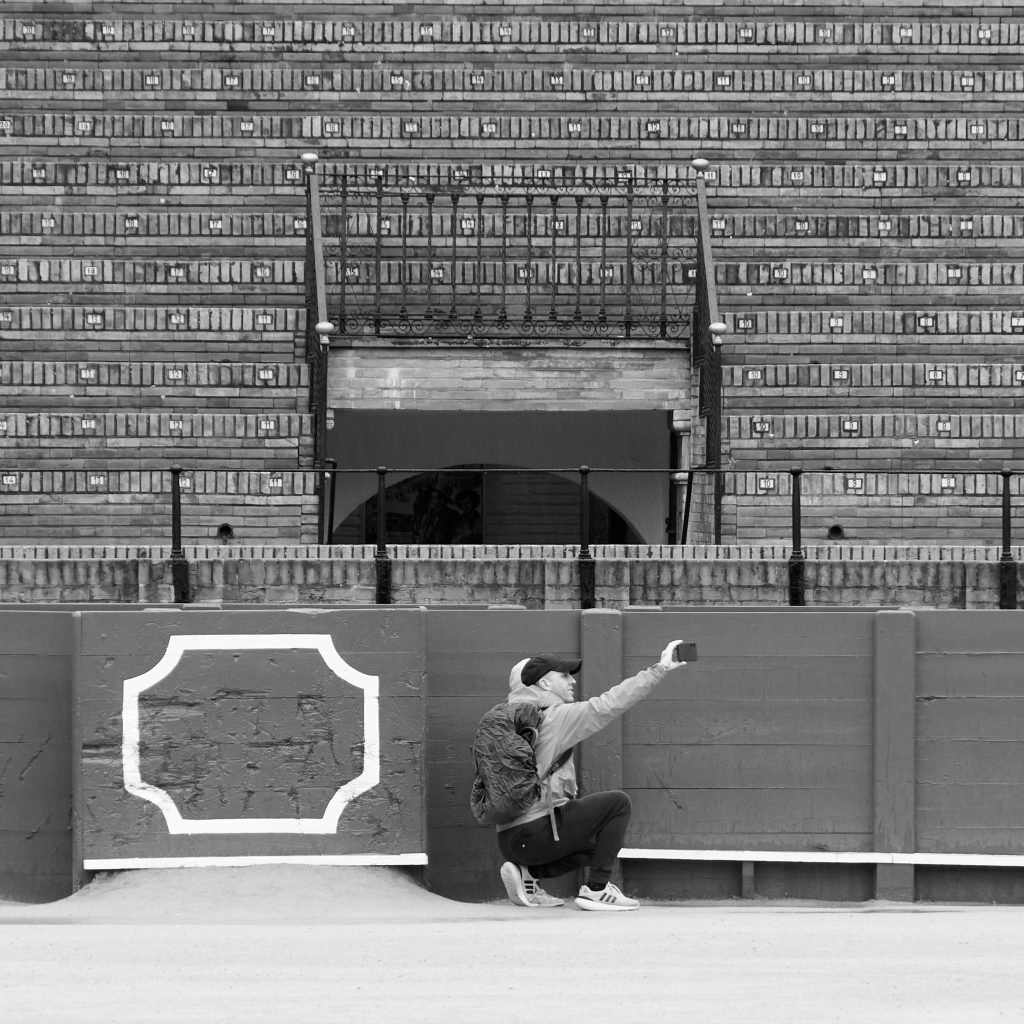
From the street, a set of main doors around the oval façade form numbered, ticketed entrances tied to a specific tendido (section), row and seat. Spectators enter into a covered inner gallery running all round the building, from which staircases and openings feed the seating tiers both above and below.
At the end of the corrida, stewards open the inner gates and the crowd drains down the stairs, through these galleries and out through the same numbered doors. The whole system is built for fast egress. In Roman theatres and amphitheatres, these passages and the flow of people was known as a vomitorium from the Latin vomere, “to spew forth”.
In design terms, their job is clear: to spew out twelve thousand people into the streets of Seville once the killing stops.
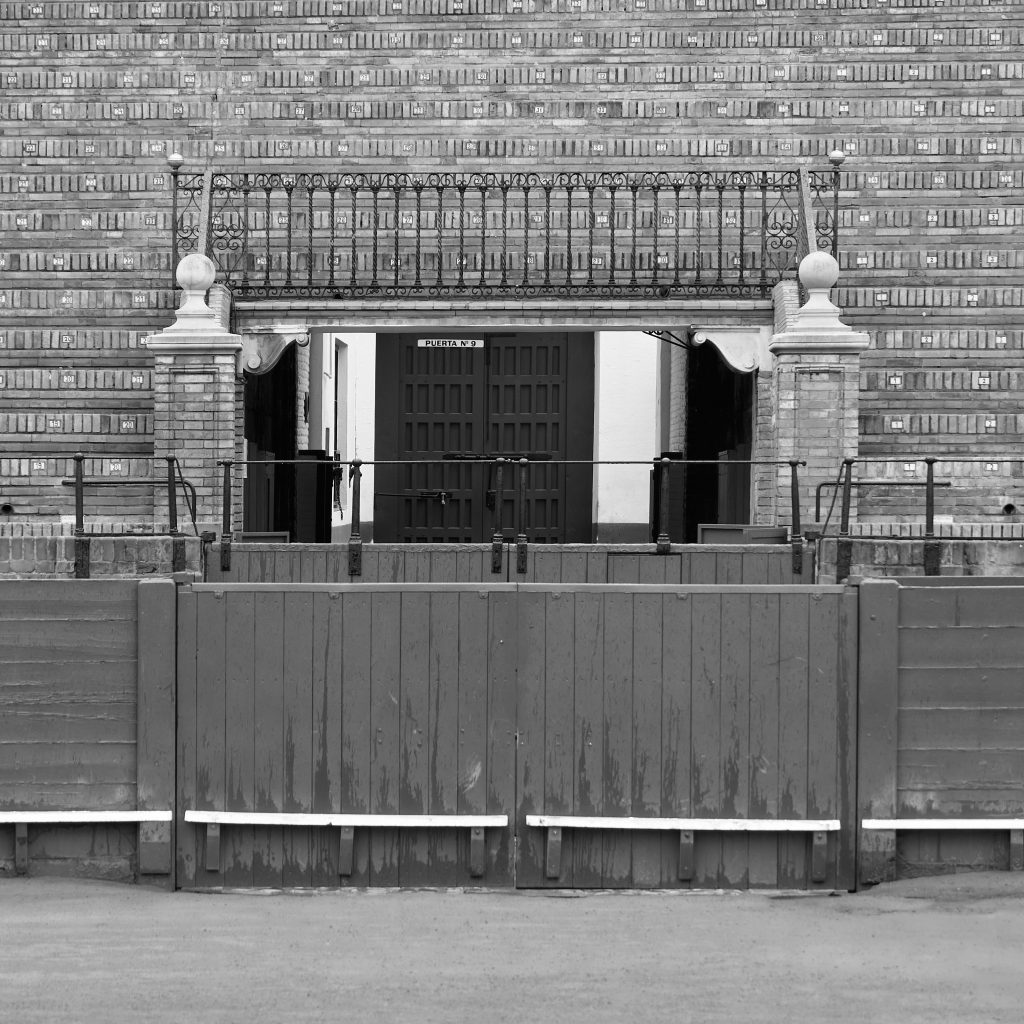
Puerta de Toriles – The Entrance of the Bulls
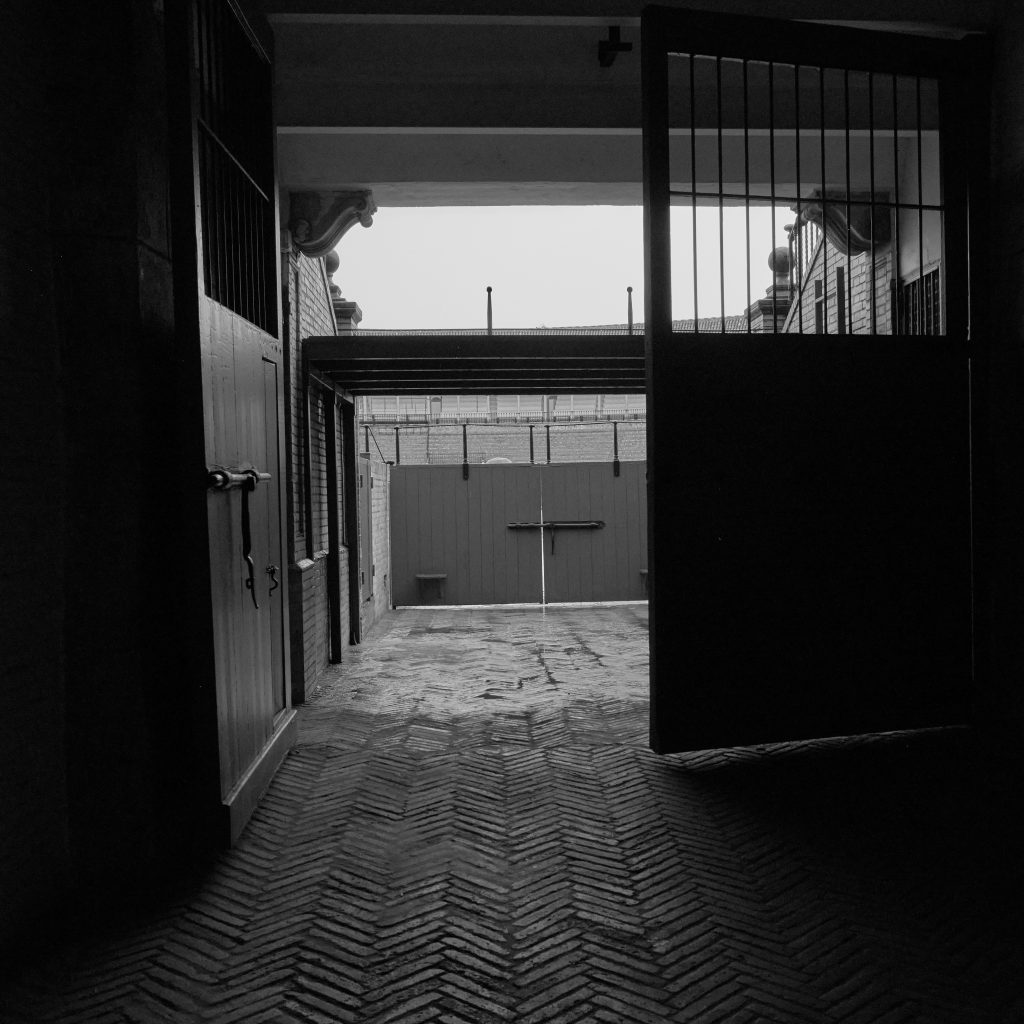
The toriles area sits on the side of the arena that faces the Prince’s gate and Royal box. The corrales, behind this are open pens where lorries unload the herd, and from which staff sort the bulls by ranch, carrying out veterinary checks before the fight. In front of the corrales, and next to the ring wall, are the chiqueros – narrow, dark boxes that hold each bull alone before its turn.
The Puerta de Toriles “por donde sale el toro a la plaza” – the one point where the bull can enter the ring links these chiqueros to the sand. There is a ritual built around this gate. At the start of the event, the alguacilillos on horseback ride to the president’s box to ask for the key. The president hands it down and the rider takes it to the torilero, to open the bull’s gate.
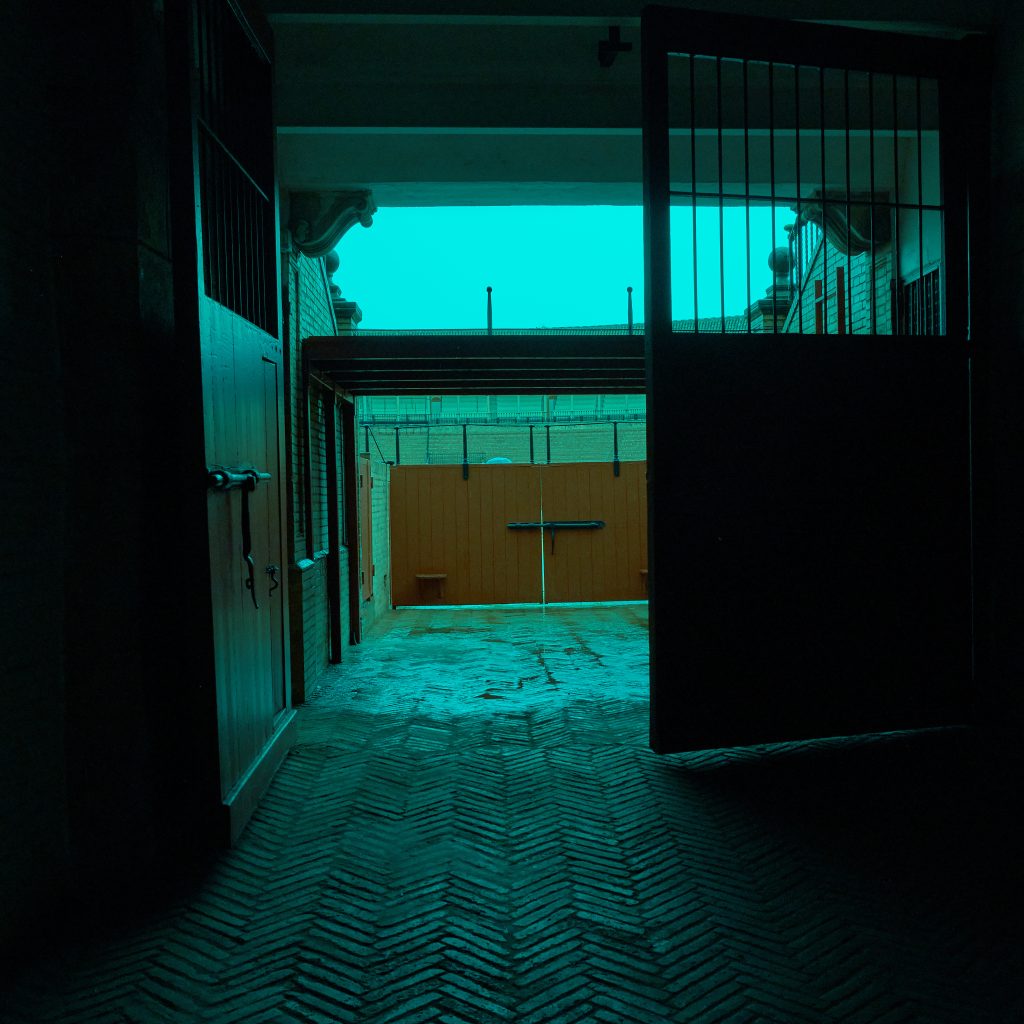
Puerta de Toriles – The Entrance of the Bulls – The Bull’s Eye View
It is a popular myth that bulls are colour-blind. However, bulls don’t see only shades of grey. They see fewer hues than we do, but they do not live in a grey fog.
Cattle have two cone types in the retina. Humans have three. This means that cattle see a blue and green spectrum, but they don’t see red in the way we do. A red cloth looks dark to them. It doesn’t blaze with heat or threat. The myth took hold because matadors move the cloth. The bull tracks the motion; the shade itself has no particular power.
This matters for two reasons. First, it shows how easy it is to frame an act of harm as a trait of the victim. The tale about bulls and red shifts blame. It hides the fact that people bait and break the bull through stress, pain, and fear. Second, it lets us ask how false ideas shape views of farm life and of the rights of non-human beings. If we treat beings as dull, we give cover to abuse.
For the animal, the shift is from a cramped dark box, through the Puerta de Toriles, to blinding light and noise. The whole design funnels that body, and the animal’s fear, to one exact point on the sand, while the crowd and the Royal box look on.
A historic study of the Maestranza notes the “zona de toriles”, with its own balcony of the Diputación set over the toriles gate, forms a clear axis – monarchy at one end, bulls at the other.
Puerta del Despejo – The Clearance Gate
We are told that the death of Victor Barrio in July 2016 was the first death of a matador since that of José Cubero “Yiyo” in 1985. However, matadors are the ‘nobles’ of the ring and there are also deaths (and, of course, injuries) among their team of banderillos and other ‘toreros’. Since modern era bullfighting emerged in 1700, there have been over 500 recorded deaths. In the last decade alone, there have been four reported (Victor Barrio – July 2016, Rodolpho Rodriguez – also in 2016, Iván Fandiño – June 2017, and Manuel Maria Trindade – August 2025). None of these figures and reports address deaths among farm workers outside the ring who are breeding and rearing the fighting bulls for much of the year.
Protection for the matador’s body, has changed little over the years. The traje de luces remains a tight silk suit tailored to show line and grace rather than padding. Some bullfighters wear light protection under the cloth, but culture still rewards a slim, ‘classic’ shape and the idea that the matador shares the bull’s exposure.
Modern rings try to answer the risk this represents with medicine rather than armour. Spanish law now calls for full medical cover inside the plaza. Big city rings market themselves as trauma centres. Pamplona, Madrid, Córdoba and Seville all house on-site infirmaries with operating theatres, teams of surgeons, and clear triage routes from sand to surgery.
The Puerta del Despejo had previously been used to drag out the bodies of dead horses, but the introduction of protective mantles reduced this need, and the gate was blocked up in the 1950s. However, when the new infirmary was created in the 2000s, it was reopened along with changes to floor levels so that the path from sand to surgery was uninterrupted – its name remains appropriate.
Puerta de Arrastre – the “Dragging Gate”
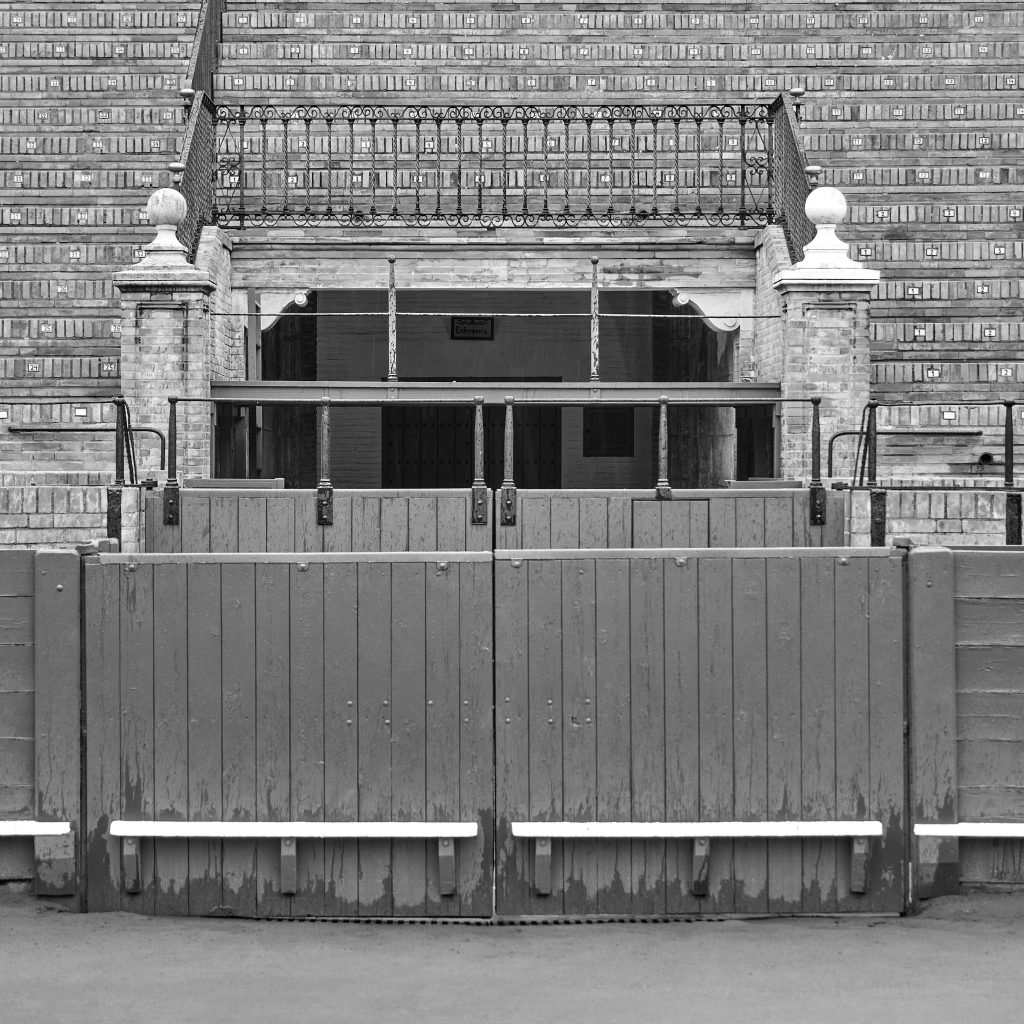
Once the bull lies still, ring staff check that it is dead. The president then calls the arrastre. A team of ‘mules’, the mulillas, come in from the patio through the puerta de arrastre, led by mulilleros in bright dress. They fix chains or a harness to the bull’s horns and set off at a brisk run. Normally, they drag the body in a straight line to the same gate. However, when the president grants a posthumous honour – a vuelta al ruedo – the team drags the bull round the full ring first.
Thus, the dead bull leaves the ruedo through the puerta de arrastre – a low but necessarily wider gate in the barrier that opens from the sand into the patio de arrastre – the service yard that links on to the skinning room and slaughter area – the desolladero. It is in this area that any bull that still shows signs of life is finally slaughtered, skinned and the body bled in hygienic conditions and under veterinary control before it is sent for butchery in refrigerated vans. The rules and processes were ‘tightened up’ in 2001, due to ‘Mad Cow Disease’.
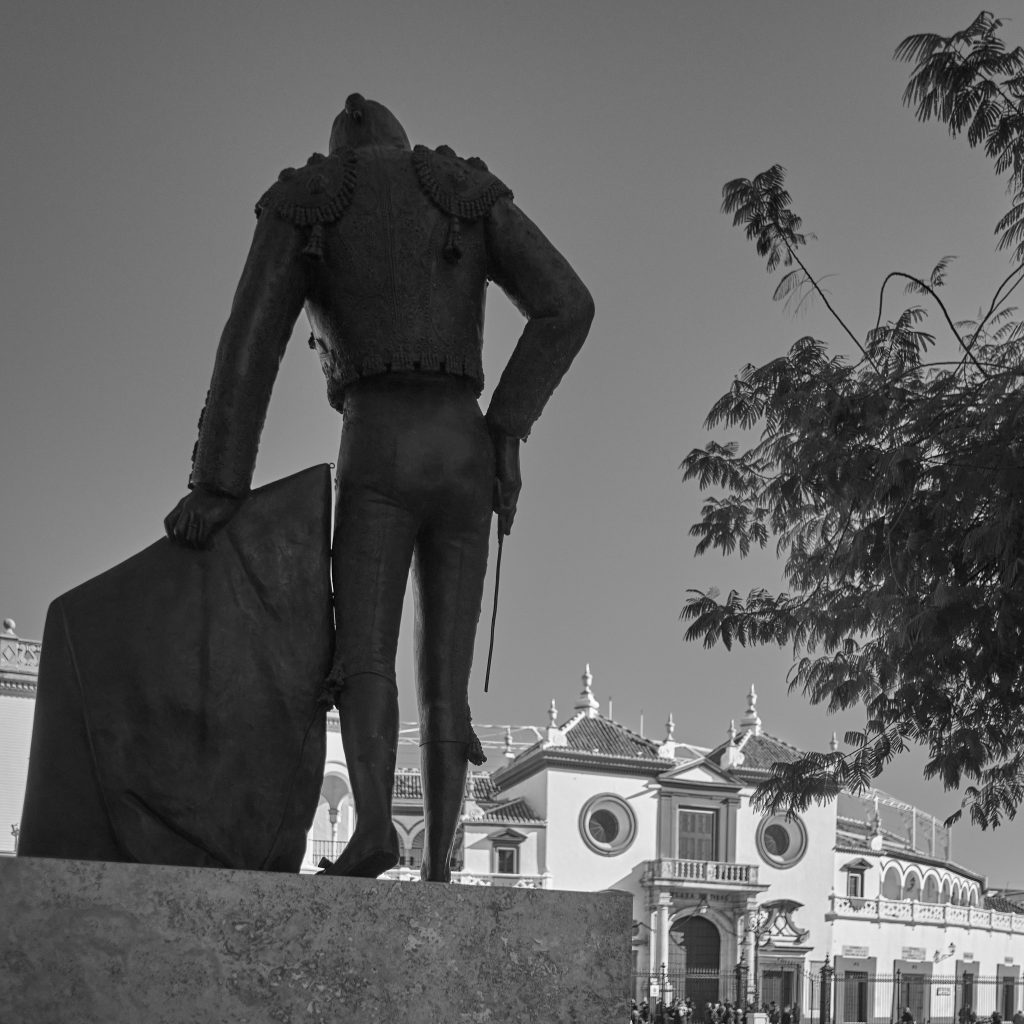
Monument to Manolo Vázquez
Manolo Vázquez was Seville’s house matador. Born in the San Bernardo district in 1929, he took the alternativa in the Maestranza in 1951 and fought more than 300 corridas before his first retirement at 39 years old in 1968. He returned, at 50 in 1981, and said farewell for good in 1983 after a major ‘triumph’ in the same ring. He lived to 75, a long life in a trade marked by blood and shock. His bronze statue, opposite the Maestranza, shows him in a classic, calm pose with the muleta. Estimates vary, but he is thought to have killed between 300 and 500 bulls.
In a classic Spanish corrida, the bull enters the ruedo once and the script says that he must die there. A “fight to the death” is built into the form of the show and into law that still treats this as a set kind of public performance.
A bull that has fought cannot go back to farm life or face the ring again. The much-publicised “pardon” of an outstanding bull, the indulto, is a very rare exception that saves only a handful of animals each year and exists to feed breeding lines, not to soften the death rate.
The idea that rings sit on the edge of town so that loose bulls pose less risk is folk talk more than fact. Some old plazas did start at the fringe, but many, like Seville or Pamplona, now lie in dense city streets. A fighting bull that breaks out is very dangerous, as the death toll at street runs shows, yet the rule that the bull does not leave the ring alive comes from the needs of the show and the meat trade, not from a wish to protect the town.
In a standard corrida, three matadors face six adult bulls and all six are killed. At Seville, the 2024 and 2025 seasons listed 24 events each year – 16 or 17 full corridas plus a horse show and six novice fights – which means in the region of 140 to 150 bulls killed per season in this ring alone.
Across Spain as a whole, animal rights groups now speak of at least 7,000 bulls killed in official rings per year, and “tens of thousands” if one adds town fiestas and linked events.
Unlock the transformative power of imagery and harness the therapeutic potentials of photography, enhancing your professional toolkit and personal growth journey. This unique day event is designed for those eager to explore how photography can be used as a powerful tool for emotional healing and personal expression. Ideal continuing professional development (CPD) for professionals in mental health, educators, and anyone interested in the intersection of art and therapy. You will embark on a journey through four distinct modules that cover both the theory and practice of Therapeutic Photography.
We begin with an Introduction to Therapeutic Photography, where you will learn about the origins, key theories, and the distinction between related practices like phototherapy.
The second session focuses on The Mechanics of Therapeutic Photography, teaching you the essential skills of camera operation, photographic techniques, and how to create environments conducive to emotional expression. This practical module ensures that you can handle equipment and techniques with confidence, applying them in ways that foster deep personal and subject reflection.
The third session, Therapeutic Photography in Practice, delves into real-world applications, showcasing how this method has been successfully implemented in various settings. Through case studies and interactive discussions, you will understand the dynamics of photo-elicitation, self-portraiture, and the critical ethical considerations that ensure respect and confidentiality.
The final session, Integration and Professional Practice, guides you on how to integrate these practices into professional settings. Whether you’re a therapist, counsellor, or educator, you will learn how to design and implement a therapeutic photography programme that aligns with your professional environment.
Please note:
Please bring a digital camera with you. This can be of any kind, including a smartphone, and ideally you will have the means of sharing one or two images taken on the day with the tutor.
This event will close to enrolments at 23:59 BST on 13 May 2026.
*** UPDATE 19/11/25 – SORRY – THIS COURSE IS NOW FULL ***
Sat 18 Jul 2026 – Sat 25 Jul 2026
Overview
This course explores how minimalist photography can change how we see Oxford (and, of course, anywhere else). We will learn how light, space, shape, and silence can say more than detail. Through short talks, walks, and group work, we will study how memory, mood, and place connect.
We will explore the psychology of space and how people form attachments to places. We will look at how we remember scenes, how emotion shapes recall, and how we often feel more than we see. We will link this to how minimalist images can stir feelings, invite thought, or suggest stories.
We will also study how we process visual detail. We will ask what happens when much is left out. Can less lead to more? Can an image still hold meaning if it is almost empty?
The course includes fieldwork in Oxford. You will make your own work and learn how to frame scenes that distil mood, memory, or meaning. You will also learn how to edit and group your images to form a visual story.
This course is open to all. You do not need to be an expert in photography or psychology, only open to thinking and seeing in new ways.
Participants are taught in small seminar groups of up to 10 students, and receive two one-on-one tutorials with their tutor.
Sunday
Seminar 1: The Psychology of Place
We explore how people form emotional and cognitive bonds with places. We consider rootedness, belonging, and the role of space in identity and memory.
Seminar 2: Spatial Memory and Image Recall
We examine how the mind stores and recalls visual scenes. We discuss salience, affect, and how memory shapes what we later ‘see’ in images.
Monday
Seminar 3: Minimalism as Visual Language
We define minimalist photography, drawing on key figures and concepts. We ask: what happens when we say more with less?
Seminar 4: Visual Perception and the Art of Noticing
We explore how we attend to and make sense of visual stimuli. We discuss attention, figure-ground, and perceptual ambiguity.
Tuesday
Seminar 5: Abstraction and Emotional Response
We consider how abstraction can create mood, provoke thought, and resist simple meaning. We link form and feeling.
Seminar 6: Simplicity, Silence, and Negative Space
We explore the visual and psychological role of negative space, silence, and restraint. We ask what is left unsaid in a minimalist frame.
Wednesday
Seminar 7: Oxford Seen Differently
We use images to challenge the tourist gaze. We ask: what is not shown in brochures? What is hidden in plain sight?
Seminar 8: Memory, Nostalgia, and Urban Myth
We explore how nostalgia colours place. We consider collective memory, imagined pasts, and the city as a symbolic site.
Thursday
Seminar 9: The Ethics of Representation
We examine what it means to photograph a place that is shared, lived-in, or loaded with history. We ask: what is fair? What is stolen?
Seminar 10: Narrative, Sequence, and Visual Storytelling
We explore how to build a sequence of images that suggests a mood or story. We discuss titles, juxtapositions, and the space between images.
Friday
Seminar 11: Curating Meaning – From Image to Exhibition
We explore how to select and group images to shape a story, theme, or mood. We discuss sequencing, layout, and the role of silence or contrast between works. We also consider space, flow, and how viewers engage with minimalist work in a physical setting. We ask: what is the work saying? What needs to be said, and what should be left unsaid?
Seminar 12: Presenting Work – Titles, Statements, and Display
We develop short texts to support the images, such as titles, captions, or a group statement. We explore tone, voice, and how to speak about abstract work without closing it down. We also discuss practical issues: mounting, layout, and inviting feedback.