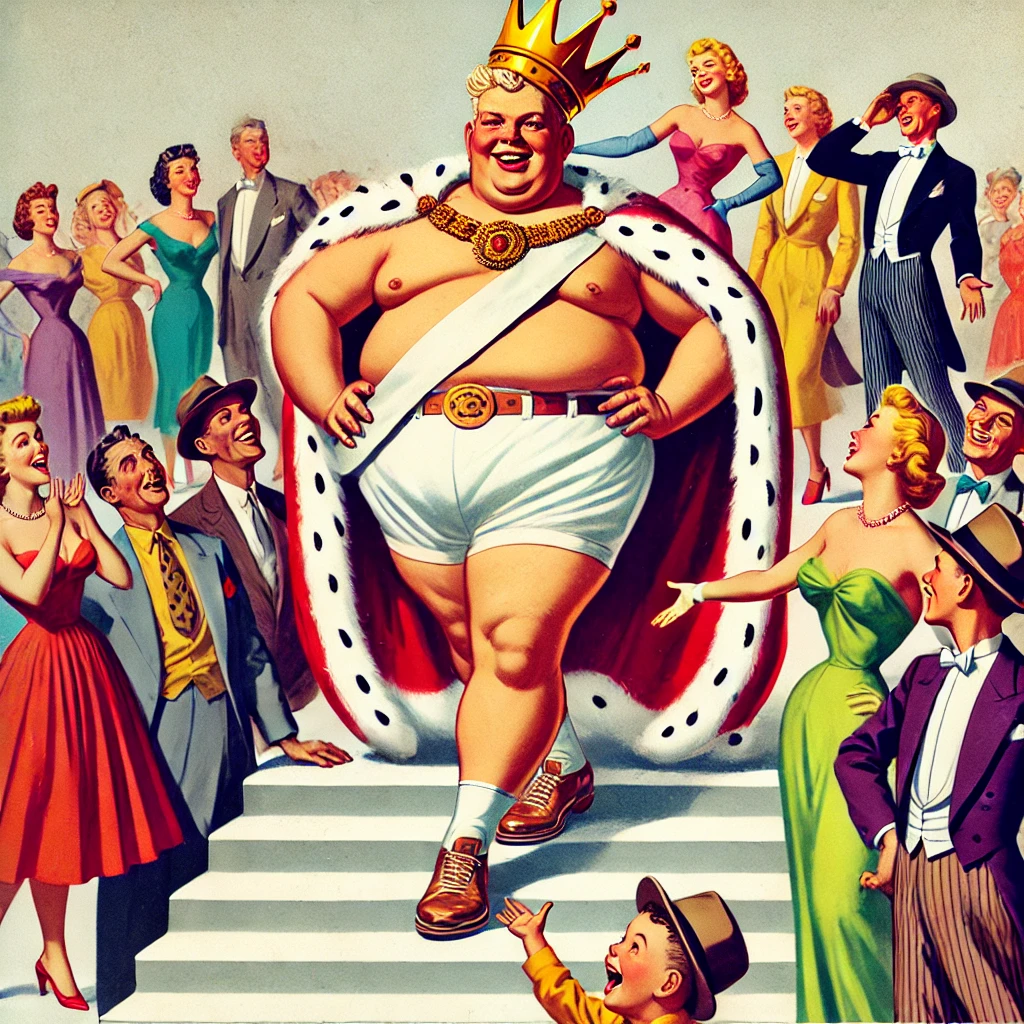
There was once a president who loved crowds more than policy. He filled his days with rallies and long speeches about himself. What he feared most was being seen as weak.
Two slick advisers came to him. They said they could make a suit so fine that only true patriots could see it. Anyone who doubted would show themselves to be un-American. This pleased the president. He thought: Now I will know who is loyal and who is not.
The advisers set up their stage. They had no cloth at all. They waved their arms and said, “Look at this fabric. It shines like gold. It is stitched with freedom itself.” The president saw nothing, but he dared not say so. He thought, If I cannot see it, others will call me a traitor.
His aides and party leaders came in. None of them could see a thing, but all cried out, “Magnificent!” They feared being cast out as weak or disloyal.
At last the day of the parade came. The president strode out, waving to the crowd in his new suit. The networks filmed him, and the commentators said how strong he looked. But the people, standing in the heat, saw only a man in his underwear.
A child, sitting on her parent’s shoulders, shouted, “He has nothing on!” The crowd fell silent. Then more voices took up the cry. Soon the square was full of laughter and anger mixed together.
The president flushed, but walked on, chin high, for he thought: If I keep marching, perhaps they will believe the lie after all.
An account of the entrances and exits of both humans and bulls
El Ruedo
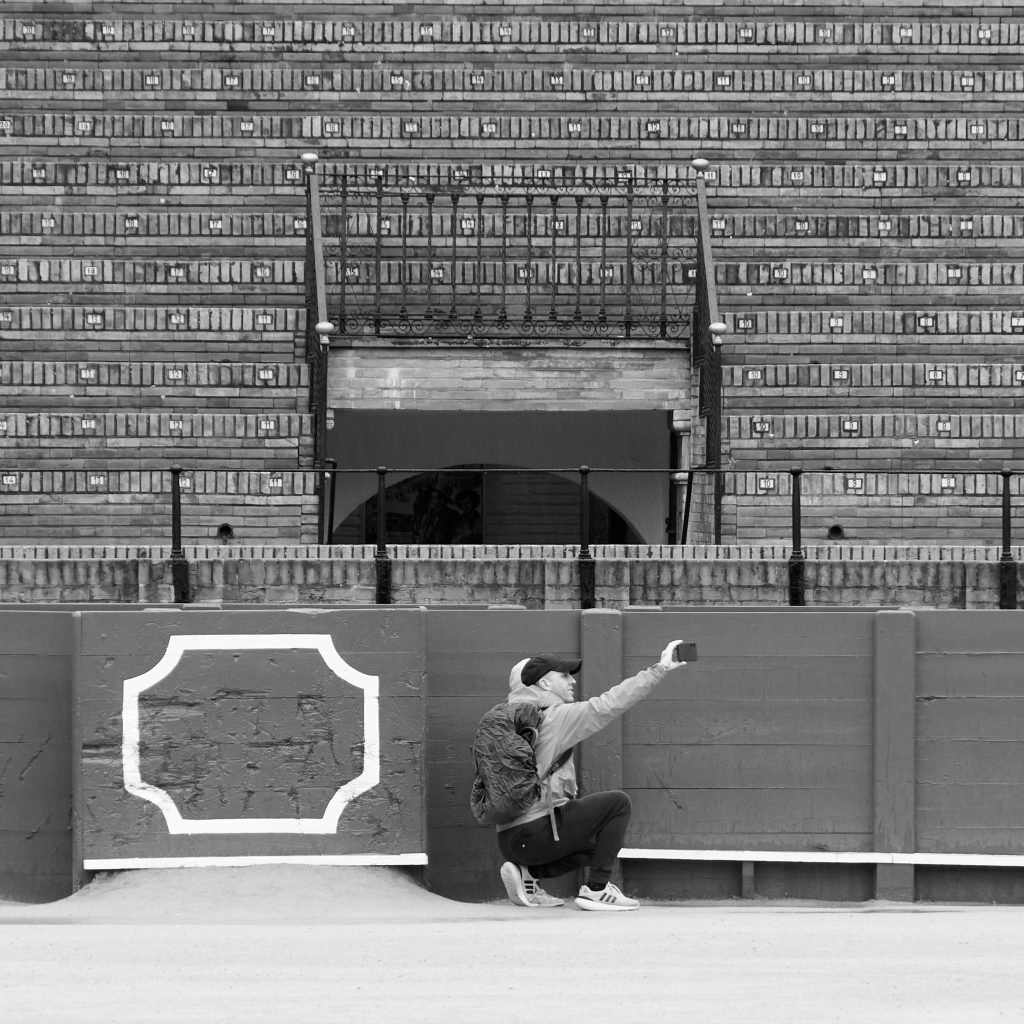
In everyday English people just say “the arena”, but in Spanish bullfighting language ruedo is the proper term for the circular performance space where the bull and bullfighter meet, as distinct from the surrounding tendidos (seating), barrera (barrier) and so on.
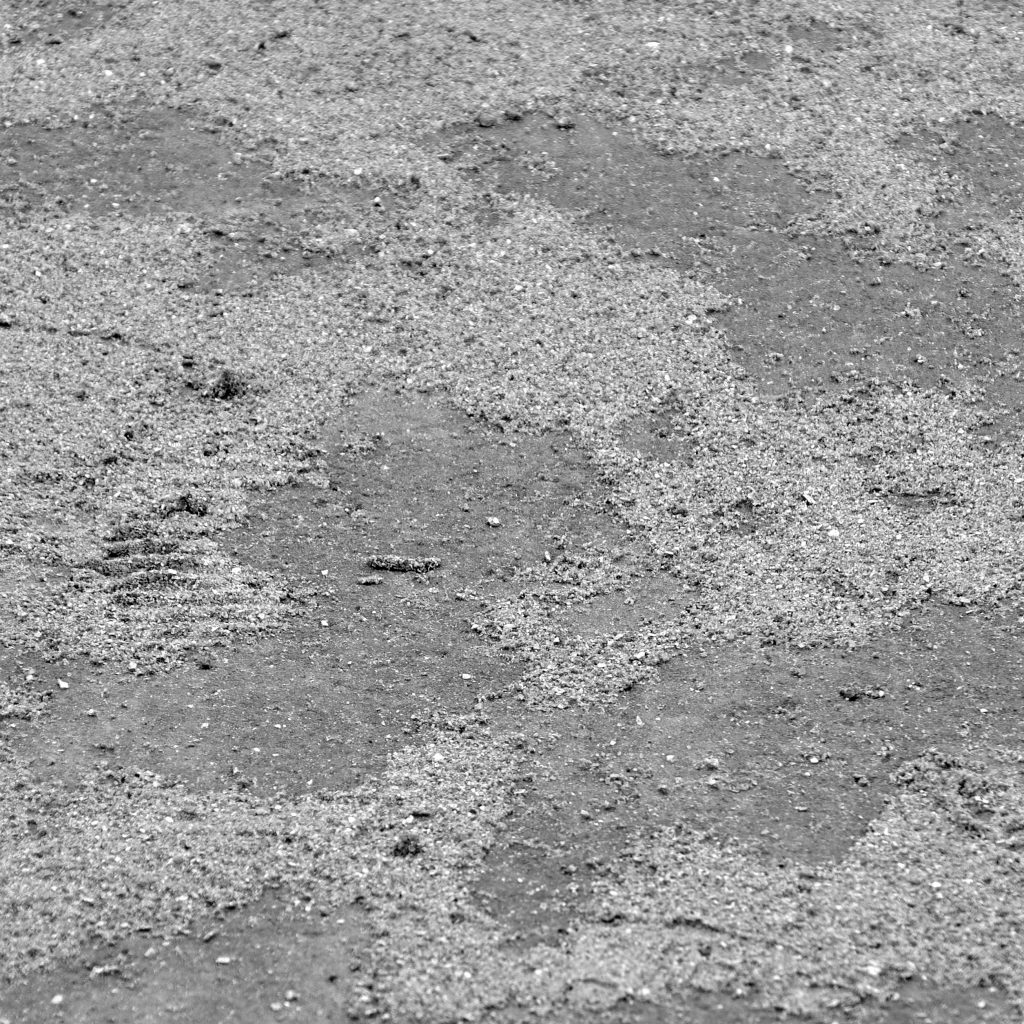
The sand used in the Seville Bullring, or Plaza de Toros de la Real Maestranza de Caballería de Sevilla, plays an important role in the spectacle of bullfighting. The arena’s surface is carefully chosen for both tradition and practicality, affecting the movement of the bull and the matador’s ability to perform.
Typically a mixture of fine, compacted earth, clay, and sometimes chalk. This combination ensures that it provides a stable, firm footing while still allowing for slight shifts in the ground when the bull charges. The specific mix is designed to absorb the impact of hooves, cushion the blows between the bull and the matador, and absorb the blood from the animals. It also creates a visually striking contrast as dust is kicked up during the fight – a visual hallmark of the events, enhancing the dramatic atmosphere.
Maintained by a team of staff, it is regularly swept and sometimes watered to keep it in the right condition. The sand must retain its consistency throughout the event, as any sudden changes could affect both the bull’s behaviour and the matador’s performance. Extra sand is spread to cover the blood after each kill, and the surface overall may be raked and smoothed between fights to ‘reset’ the arena.
In bullfighting culture, the sand represents the brutal, ritualistic nature of the event. It’s not just a practical surface but part of the symbolic landscape of the fight, connecting the spectators to the physicality of the confrontation.
Puerta del Príncipe – The Prince’s Gate
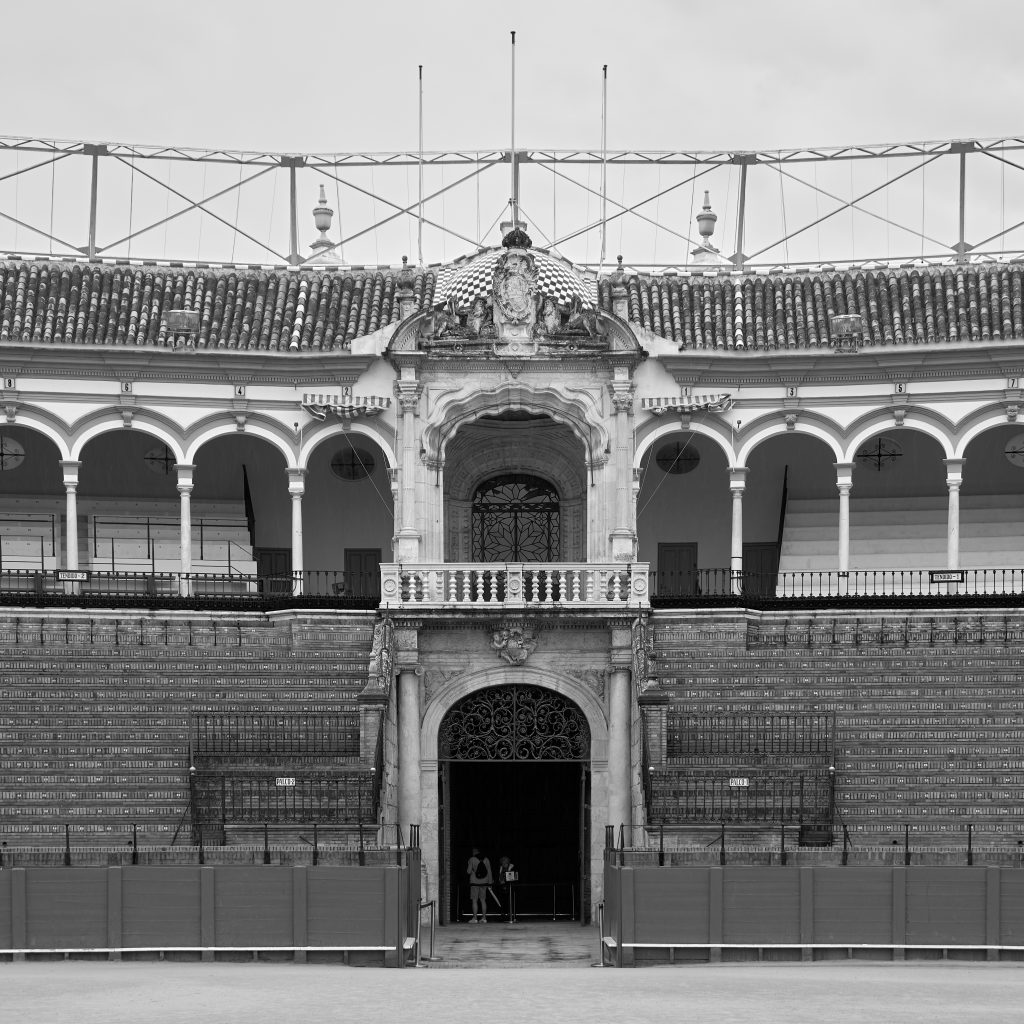
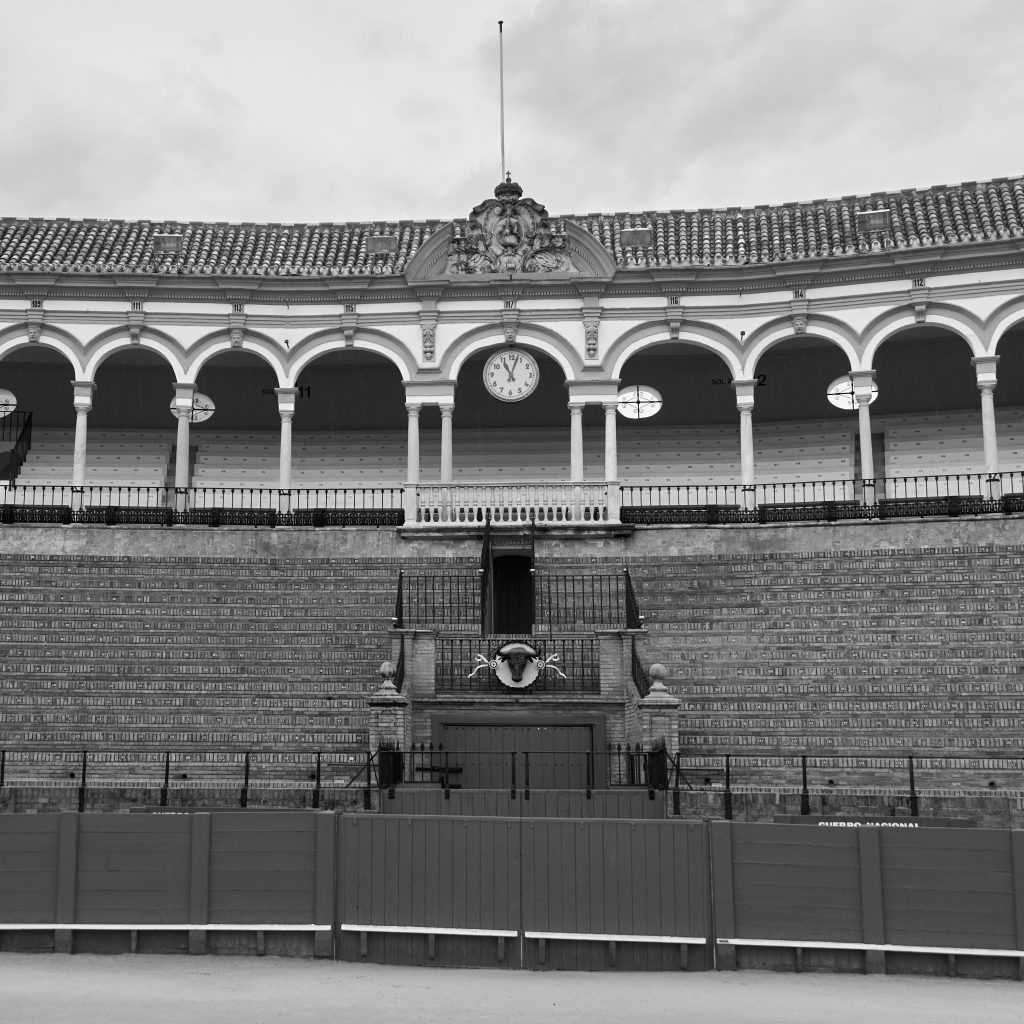
Presenting the main Baroque façade to the river, with doors for the Maestranza nobles and civil authorities, the Prince’s Gate, is about rank, ritual and image. It states who rules the space, and who earns glory inside it.
The inner façade dates from 1765, built for the Bourbon prince Felipe, son of Felipe V. The upper gallery is the Royal Box (Palco del Príncipe), still used by the royal family. The half-dome roof, white and blue tiles, and sculpted group on the top mark it as the visual “crown” of the arena.
The lower part forms the main ceremonial gate into the arena. The Royal box aligns with the long axis of the ring, drawing the eye from almost every seat, and works as a “royal presence” even when no monarch sits there. The famous Puerta del Príncipe is the ritual exit that every matador wants.
The ears and tail are awarded to a matador by the president when urged by the crowd. Since 1982, a matador must earn at least three ears in one afternoon to leave by this gate. To raise the bar for ‘celebrity’ matadors, who fight alone, they must be awarded four ears. Matadors who achieve this leave on the shoulders of their cuadrilla and fans, through that door and out to the Paseo de Cristóbal Colón.
The Vomitoria
From the street, a set of main doors around the oval façade form numbered, ticketed entrances tied to a specific tendido (section), row and seat. Spectators enter into a covered inner gallery running all round the building, from which staircases and openings feed the seating tiers both above and below.
At the end of the corrida, stewards open the inner gates and the crowd drains down the stairs, through these galleries and out through the same numbered doors. The whole system is built for fast egress. In Roman theatres and amphitheatres, these passages and the flow of people was known as a vomitorium from the Latin vomere, “to spew forth”.
In design terms, their job is clear: to spew out twelve thousand people into the streets of Seville once the killing stops.
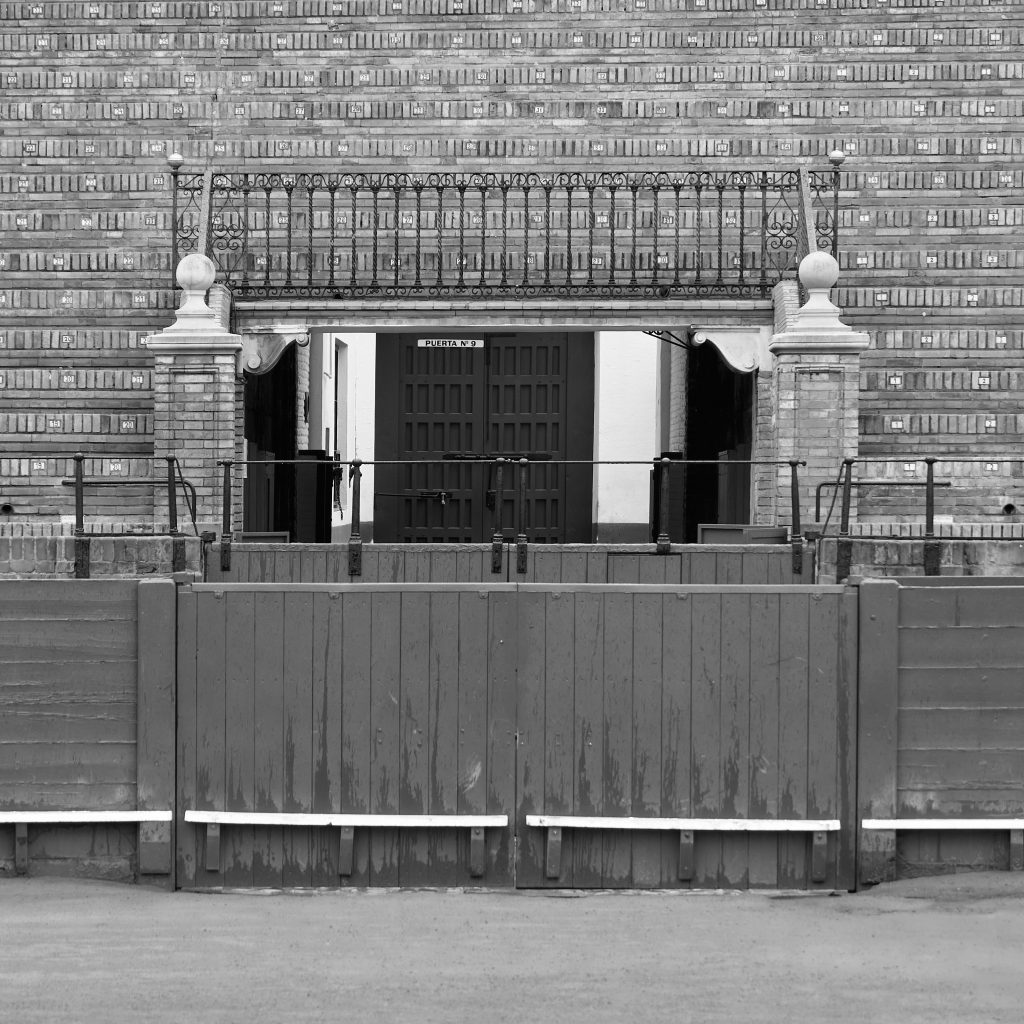
Puerta de Toriles – The Entrance of the Bulls
The toriles area sits on the side of the arena that faces the Prince’s gate and Royal box. The corrales, behind this are open pens where lorries unload the herd, and from which staff sort the bulls by ranch, carrying out veterinary checks before the fight. In front of the corrales, and next to the ring wall, are the chiqueros – narrow, dark boxes that hold each bull alone before its turn.
The Puerta de Toriles “por donde sale el toro a la plaza” – the one point where the bull can enter the ring links these chiqueros to the sand. There is a ritual built around this gate. At the start of the event, the alguacilillos on horseback ride to the president’s box to ask for the key. The president hands it down and the rider takes it to the torilero, to open the bull’s gate.
Puerta de Toriles – The Entrance of the Bulls – The Bull’s Eye View
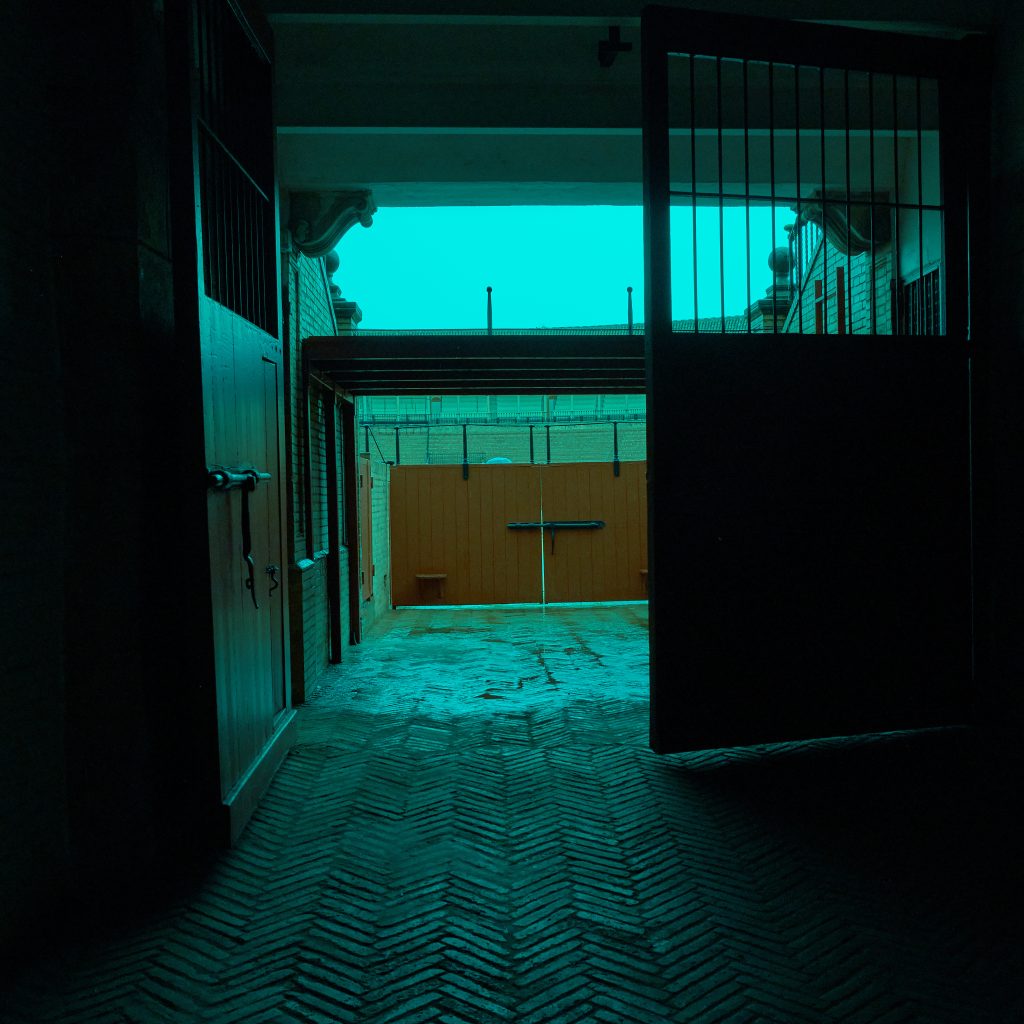
It is a popular myth that bulls are colour-blind. However, bulls don’t see only shades of grey. They see fewer hues than we do, but they do not live in a grey fog.
Cattle have two cone types in the retina. Humans have three. This means that cattle see a blue and green spectrum, but they don’t see red in the way we do. A red cloth looks dark to them. It doesn’t blaze with heat or threat. The myth took hold because matadors move the cloth. The bull tracks the motion; the shade itself has no particular power.
This matters for two reasons. First, it shows how easy it is to frame an act of harm as a trait of the victim. The tale about bulls and red shifts blame. It hides the fact that people bait and break the bull through stress, pain, and fear. Second, it lets us ask how false ideas shape views of farm life and of the rights of non-human beings. If we treat beings as dull, we give cover to abuse.
For the animal, the shift is from a cramped dark box, through the Puerta de Toriles, to blinding light and noise. The whole design funnels that body, and the animal’s fear, to one exact point on the sand, while the crowd and the Royal box look on.
A historic study of the Maestranza notes the “zona de toriles”, with its own balcony of the Diputación set over the toriles gate, forms a clear axis – monarchy at one end, bulls at the other.
Puerta del Despejo – The Clearance Gate
We are told that the death of Victor Barrio in July 2016 was the first death of a matador since that of José Cubero “Yiyo” in 1985. However, matadors are the ‘nobles’ of the ring and there are also deaths (and, of course, injuries) among their team of banderillos and other ‘toreros’. Since modern era bullfighting emerged in 1700, there have been over 500 recorded deaths. In the last decade alone, there have been four reported (Victor Barrio – July 2016, Rodolpho Rodriguez – also in 2016, Iván Fandiño – June 2017, and Manuel Maria Trindade – August 2025). None of these figures and reports address deaths among farm workers outside the ring who are breeding and rearing the fighting bulls for much of the year.
Protection for the matador’s body, has changed little over the years. The traje de luces remains a tight silk suit tailored to show line and grace rather than padding. Some bullfighters wear light protection under the cloth, but culture still rewards a slim, ‘classic’ shape and the idea that the matador shares the bull’s exposure.
Modern rings try to answer the risk this represents with medicine rather than armour. Spanish law now calls for full medical cover inside the plaza. Big city rings market themselves as trauma centres. Pamplona, Madrid, Córdoba and Seville all house on-site infirmaries with operating theatres, teams of surgeons, and clear triage routes from sand to surgery.
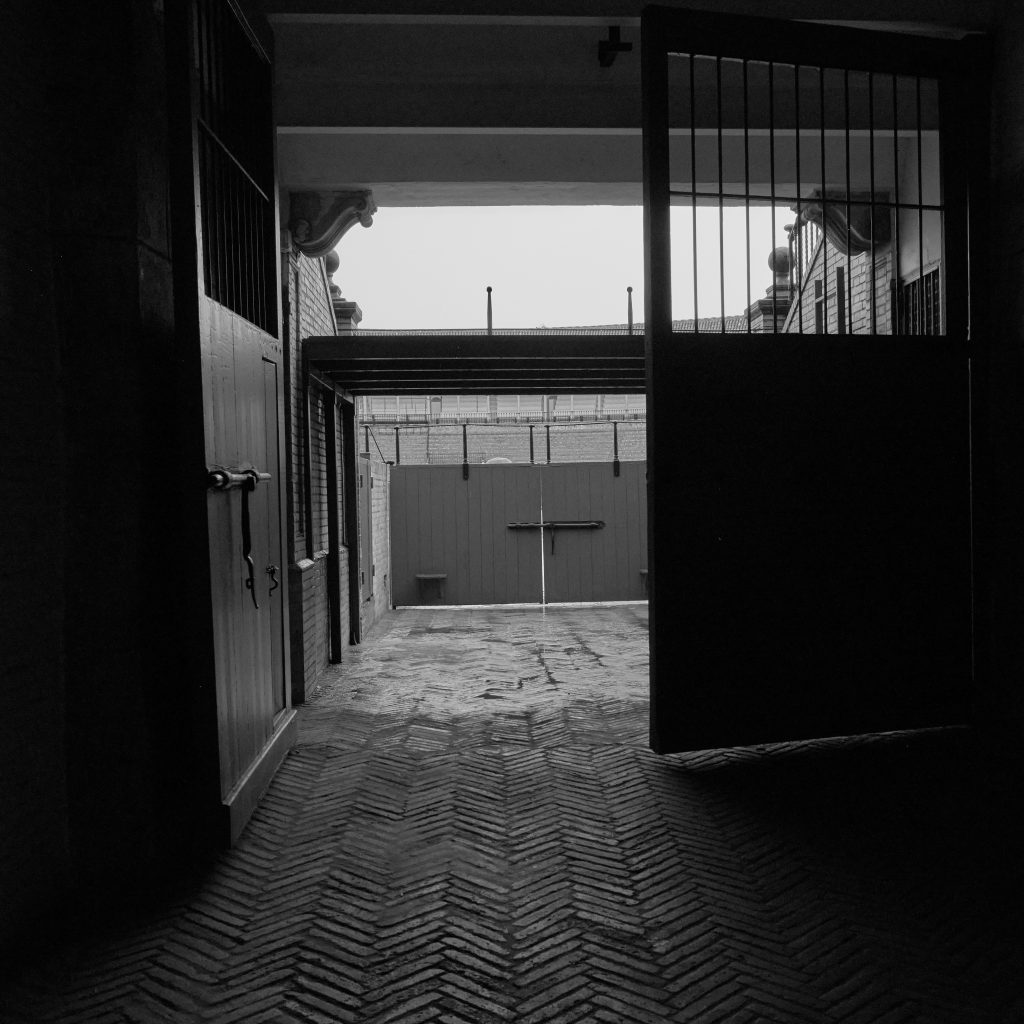
The Puerta del Despejo had previously been used to drag out the bodies of dead horses, but the introduction of protective mantles reduced this need, and the gate was blocked up in the 1950s. However, when the new infirmary was created in the 2000s, it was reopened along with changes to floor levels so that the path from sand to surgery was uninterrupted – its name remains appropriate.
Puerta de Arrastre – the “Dragging Gate”
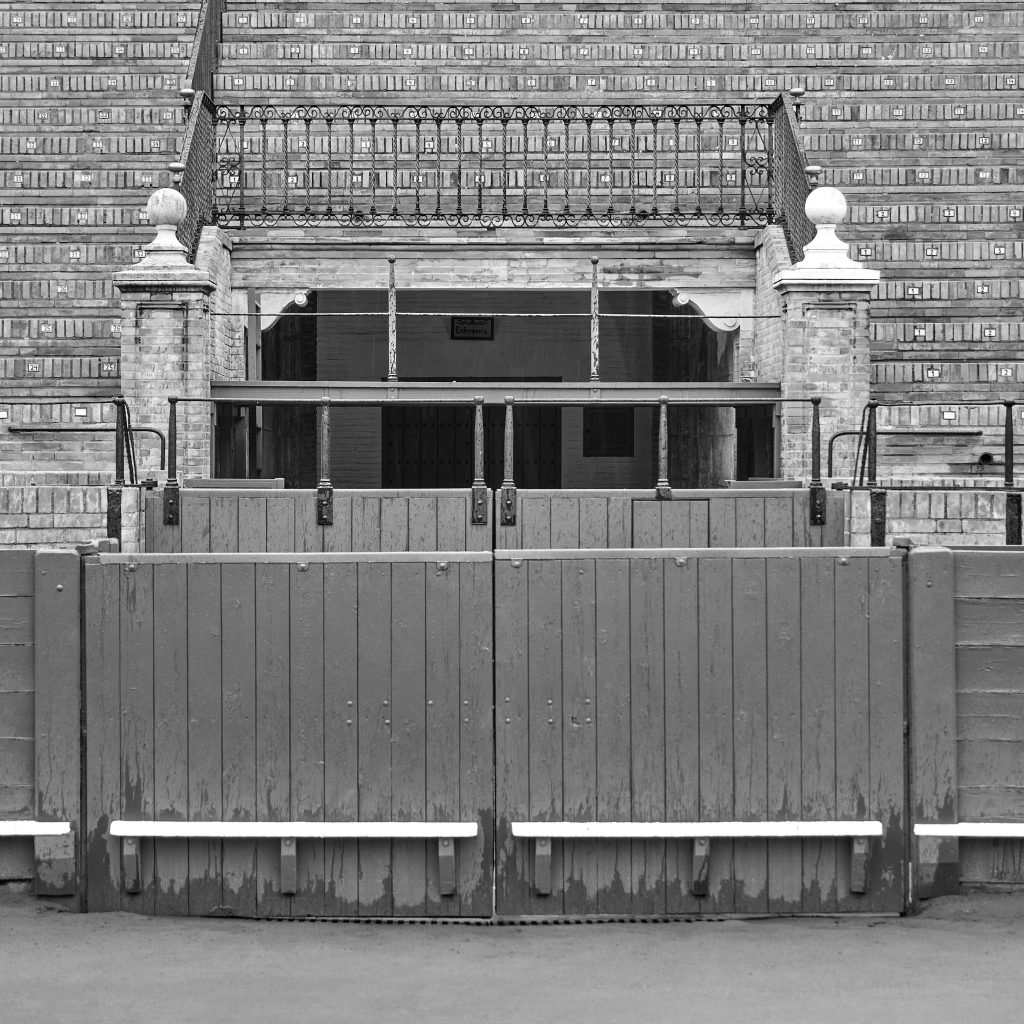
Once the bull lies still, ring staff check that it is dead. The president then calls the arrastre. A team of ‘mules’, the mulillas, come in from the patio through the puerta de arrastre, led by mulilleros in bright dress. They fix chains or a harness to the bull’s horns and set off at a brisk run. Normally, they drag the body in a straight line to the same gate. However, when the president grants a posthumous honour – a vuelta al ruedo – the team drags the bull round the full ring first.
Thus, the dead bull leaves the ruedo through the puerta de arrastre – a low but necessarily wider gate in the barrier that opens from the sand into the patio de arrastre – the service yard that links on to the skinning room and slaughter area – the desolladero. It is in this area that any bull that still shows signs of life is finally slaughtered, skinned and the body bled in hygienic conditions and under veterinary control before it is sent for butchery in refrigerated vans. The rules and processes were ‘tightened up’ in 2001, due to ‘Mad Cow Disease’.
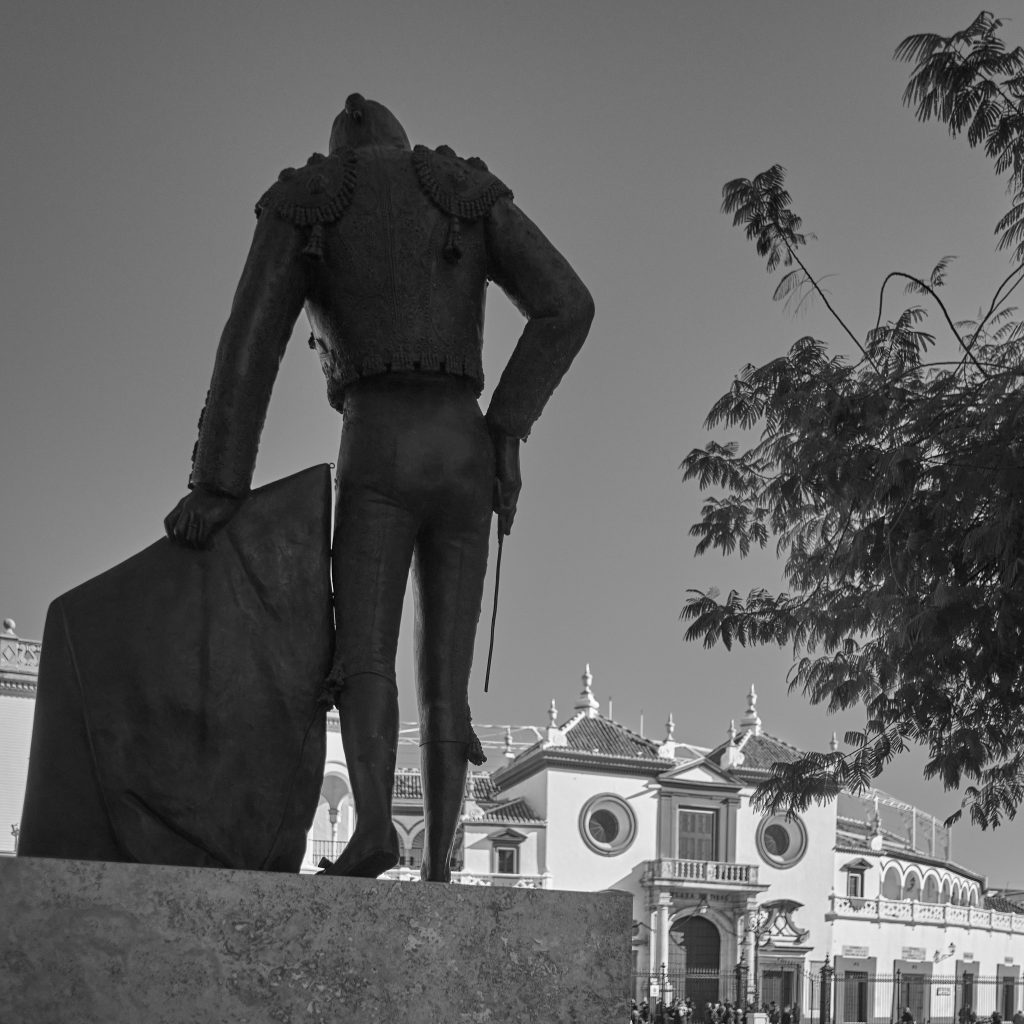
Monument to Manolo Vázquez
Manolo Vázquez was Seville’s house matador. Born in the San Bernardo district in 1929, he took the alternativa in the Maestranza in 1951 and fought more than 300 corridas before his first retirement at 39 years old in 1968. He returned, at 50 in 1981, and said farewell for good in 1983 after a major ‘triumph’ in the same ring. He lived to 75, a long life in a trade marked by blood and shock. His bronze statue, opposite the Maestranza, shows him in a classic, calm pose with the muleta. Estimates vary, but he is thought to have killed between 300 and 500 bulls.
In a classic Spanish corrida, the bull enters the ruedo once and the script says that he must die there. A “fight to the death” is built into the form of the show and into law that still treats this as a set kind of public performance.
A bull that has fought cannot go back to farm life or face the ring again. The much-publicised “pardon” of an outstanding bull, the indulto, is a very rare exception that saves only a handful of animals each year and exists to feed breeding lines, not to soften the death rate.
The idea that rings sit on the edge of town so that loose bulls pose less risk is folk talk more than fact. Some old plazas did start at the fringe, but many, like Seville or Pamplona, now lie in dense city streets. A fighting bull that breaks out is very dangerous, as the death toll at street runs shows, yet the rule that the bull does not leave the ring alive comes from the needs of the show and the meat trade, not from a wish to protect the town.
In a standard corrida, three matadors face six adult bulls and all six are killed. At Seville, the 2024 and 2025 seasons listed 24 events each year – 16 or 17 full corridas plus a horse show and six novice fights – which means in the region of 140 to 150 bulls killed per season in this ring alone.
Across Spain as a whole, animal rights groups now speak of at least 7,000 bulls killed in official rings per year, and “tens of thousands” if one adds town fiestas and linked events.
Earlier in the month, I posted details of the first ‘pilot’ of my project “Sentient Souls”. The first set of images were of abused animals presented as photographers. Project: Sentient Souls – The Photographers – Utopia
Having bounced this off a couple of trusted individuals, I went ahead and produced a range of these studies: In the Library, The Artist, The Gourmand, The Hunter, The Singer, and The Laboratory. Along with an expanded set of notes, they are now available as a catalogue on Amazon: https://amzn.to/3ZTVBmj
The Singer is the only set based around one species. Chickens have a repertoire of more than 24 calls used to communicate with one another. It seemed appropriate to give them a project of their own based on different forms of song…
After the book was produced, I was asked why I hadn’t included any turkeys. A very fair question. This led to a single image accompanied by a short story in the style of Orwell’s Animal Farm: Pilgrim’s Tale – A Christmas (and Thanksgiving) Carol – Utopia. However, in producing this image there a few alternatives that just didn’t hit the mark for me. One of these is the featured image above.
Pilgrim the Turkey was not like the others on the farm. When the Great Culling came, he hid in the brambles, his trembling feathers camouflaged by the thick, thorny undergrowth. From his hiding spot, he witnessed the farmer and his helpers dragging away his kin, their plaintive cries echoing in the crisp winter air. The slaughterhouse smoke rose thick and black on the horizon, marking the end of his flock and the beginning of his solitude.
For days, Pilgrim wandered the now-silent fields, avoiding the barn where the scent of his lost companions lingered. The sheep bleated their usual ignorance, and the pigs, fat and self-satisfied, paid him no mind. Yet the hens whispered of his survival, calling him the “Last Feather,” a ghost of a bird who had outwitted the inevitable. Pilgrim, however, did not feel like a hero. He felt like a coward.
One evening, as the setting sun cast long shadows over the farm, Pilgrim perched on the roof of the empty coop, gazing at the distant slaughterhouse. The sight of it filled him with both dread and resolve. “They will come again,” he muttered to himself. “And when they do, there must be turkeys to meet them.”
Pilgrim’s mission began the next day. He scratched the earth with purpose, gathering worms and seeds to regain his strength. Slowly, he coaxed the hens to lend him their eggs. “It is not for me,” he assured them, his voice low and solemn. “It is for the future of the flock.”
The pigs sneered when they heard of Pilgrim’s efforts. Napoleon, the largest and greediest, waddled up to him one morning. “Why bother?” he scoffed, his snout dripping with slop. “Turkeys are good for one thing, and it isn’t living.”
Pilgrim met the pig’s gaze, his beady eyes shining with defiance. “Perhaps,” he said, “but even a harvest must have seeds.”
Months passed, and Pilgrim’s small flock began to grow. He taught the young poults how to forage, how to hide, and how to recognise the farmer’s heavy boots. He warned them of the traps laid not in the woods but in their own minds—the complacency that had doomed their predecessors. “Survival,” he told them, “is an act of rebellion.”
But as spring turned to summer, whispers began to circulate. The hens clucked nervously, and the sheep’s bleating took on a note of panic. The farmer had ordered new crates, sturdier and larger than before. Pilgrim watched as the pigs feigned ignorance, their bellies swelling with stolen corn.
When the boots came again, Pilgrim’s flock stood ready. But to his horror, many of the young turkeys, emboldened by their training, marched willingly toward the farmer. “We will show them we are strong,” they said. Pilgrim called after them, his voice cracking with desperation. “Strength is not in sacrifice! Strength is in survival!”
As the slaughterhouse smoke rose once more, Pilgrim perched on the hill, his feathers heavy with failure. Yet even then, he resolved to try again. For what else could a turkey do but persist?
Turkeys as Sentient Souls: Turkeys are sentient beings capable of experiencing a range of emotions and exhibiting complex social behaviours. They form strong social bonds, display affection, and engage in communal activities. For instance, turkeys have been observed holding “great wakes” over fallen companions, indicating a capacity for empathy and mourning.
In natural settings, turkeys can live up to 10 years, during which they develop intricate social structures within their flocks. They express emotions such as happiness and fear, and have been known to protect their young and groom each other, showcasing their affectionate nature.
These behaviours suggest that turkeys are not mere automatons but sentient creatures with the ability to perceive and experience the world around them. Recognizing their sentience is crucial for understanding their needs and ensuring their well-being.
The Twice Annual “Great Culling”: Each year, approximately 620 million turkeys are slaughtered worldwide for meat. In the United Kingdom, around 9 million turkeys are killed annually for human consumption. In the United States, about 250 million turkeys are slaughtered each year.
Animal Farm: In Animal Farm by George Orwell, there is no mention of turkeys. The animals on the farm primarily include pigs, horses, dogs, sheep, hens, cows, and birds like pigeons. Each of these animals serves an allegorical purpose tied to Orwell’s critique of Soviet communism and human nature.
Pilgrim: A nod to Thanksgiving and the turkey’s association with sacrifice, linking it to ideas of displacement and marginalisation.
Symbolic role: A Gullible Idealist. Turkeys are often associated with being naïve or foolish in popular culture. Orwell could have used the turkey to show how well-meaning but less critical individuals were duped into supporting the revolution, only to face betrayal or elimination.
This year, I shall have been involved in lifesaving for 48 years. Friends often ask me why. Well, today gives a pretty good insight into my reasons.
Between 11am and 4pm, a group of four lifesaving instructors, taught rope-throwing rescues to 200+ people and CPR to 50+. We were at an area of Walton-on-Thames, beside the River, as part of a multi-agency water safety event. Organised by Surrey Fire and Rescue Service, and attended by ourselves, the Surrey Search and Rescue charity, the Police, and the Maritime Volunteer Service, it provided the opportunity to engage with a broad cross-section of the community in an area in which there have been three times the number of drownings this year compared to previous ones.
The members of the public ranged from very young children to ‘mature’ grandparents, some were on their own ‘just walking past’; there were young couples and couples who were young at heart; cyclists, joggers, and even some wedding guests!
A few vignettes…
The five-year-old Asian boy, who was so excited at learning to throw a line to someone who could be drowning, that half-an-hour later he returned with three of his best friends to show them.
The lady in the wheelchair who surprised herself.
The two sisters and their younger brother whose instructions to the casualty could probably be heard on the other side of the River.
The guy with mental health issues who had seen a mate ‘go in’ and didn’t know what to do.
The six-year-old autistic boy who threw the rope dead straight to its full 15 metres length, landing it straight across the outstretched arms of the casualty… not once but three times – jumping up and down with excitement each time!
The group of four Russian-speaking nannies, who thought it was such a great opportunity that one of them rang her employers and asked if she could collect the kids and bring them down to the River to have a go even though it was her day off.
The three grannies who, independently, persuaded their charges that they should learn CPR together (“It’s a really useful skill to have.”)
The rowing coach who, reluctant at first, had a go then realised that this was actually something that his rowers and club members should all learn…
I could go on. Why do I do this? Of course, there’s the grand moral purpose to save lives, prevent drowning, encourage water safety. However, those could all be achieved in other ways and I don’t think they alone would sustain someone’s motivation for 48 years. The answer is a bit deeper. I am not a religious person, but to see human beings of every background, all kinds of circumstances, and with so many personal stories, ‘having a go’ – stepping outside their personal comfort zone – wanting to know what they could do if ever they had to. There are so many horrifying things happening all around us, that it’s seeing people like this that restores your faith in humanity. It’s that kind of spiritual buzz that keeps me involved in initiatives like this. And, do you know what? I have a pretty strong feeling that I am not the only one!?
Treating a person, an animal, and even (under some circumstances) inanimate objects themselves, as an object or a thing with limited rights is known as objectification. There are plenty of ways in which this is achieved; treating them as a tool for another’s purposes, as lacking the wherewithall to make up their own mind, as interchangeable with someone or something else (lacking “specialness”), as something you can damage indiscriminately, that can be owned or sold, without concern for their feelings. In a sexual context, ignoring the whole and focusing on (body) parts, ignoring anything other than appearance, and treating them as though they have nothing to say.
Photographers, frequently portray their subjects in ways that could be described as objectification. Much ‘glamour’ photography, especially if it is taken without a purpose other than for the satisfaction of the photographer, would be an obvious example. A documentary about a group of people already marginalised by society where the images and text do nothing to advance their interests and condition, would be another.
Therein lies the clue… context is all important. An image in isolation, may appear to objectify the subject, but might be given context by other images and by explanatory text.
One person, in a position of authority and in a situation where I had no opportunity to respond, criticized my street photography claiming that it was voyeuristic. A simple analysis showed that, if it is, then it’s a lot less so than many well known, and highly regarded practitioners of the art. My argument would be that my images always have a context – usually one that is very clear to a casual observer. Occasionally, the subtlety might need to be explained – but generally that would mean that the image has become too complex.
To demonstrate my point, I decided to develop a small project that portrays a subject in two ways – one in context, and one isolated to the point of objectification. I wanted someone or something that was sufficiently commonplace that most people would be used to objectifying them. I soon settled on the letter box. Not the kind you have in your door, but the postal containers present in almost every community – whether cylindrical, on a pole, or a slit in the wall.
I soon realised that I had inadvertently chosen the ideal metaphor as, it seems, many people take pictures of letter boxes, but very few put them in context.
I shall be collating the images into a final set in the future, but for the time being here’s a selection of early examples.