Category: Projects – General Documentary

  • Project: Plaza de Toros de la Real Maestranza de Caballería de Sevilla

    An account of the entrances and exits of both humans and bulls

    El Ruedo

    In everyday English people just say “the arena”, but in Spanish bullfighting language ruedo is the proper term for the circular performance space where the bull and bullfighter meet, as distinct from the surrounding tendidos (seating), barrera (barrier) and so on.

    The sand used in the Seville Bullring, or Plaza de Toros de la Real Maestranza de Caballería de Sevilla, plays an important role in the spectacle of bullfighting. The arena’s surface is carefully chosen for both tradition and practicality, affecting the movement of the bull and the matador’s ability to perform.

    Typically a mixture of fine, compacted earth, clay, and sometimes chalk. This combination ensures that it provides a stable, firm footing while still allowing for slight shifts in the ground when the bull charges. The specific mix is designed to absorb the impact of hooves, cushion the blows between the bull and the matador, and absorb the blood from the animals. It also creates a visually striking contrast as dust is kicked up during the fight – a visual hallmark of the events, enhancing the dramatic atmosphere.

    Maintained by a team of staff, it is regularly swept and sometimes watered to keep it in the right condition. The sand must retain its consistency throughout the event, as any sudden changes could affect both the bull’s behaviour and the matador’s performance. Extra sand is spread to cover the blood after each kill, and the surface overall may be raked and smoothed between fights to ‘reset’ the arena.

    In bullfighting culture, the sand represents the brutal, ritualistic nature of the event. It’s not just a practical surface but part of the symbolic landscape of the fight, connecting the spectators to the physicality of the confrontation.
    Puerta del Príncipe – The Prince’s Gate

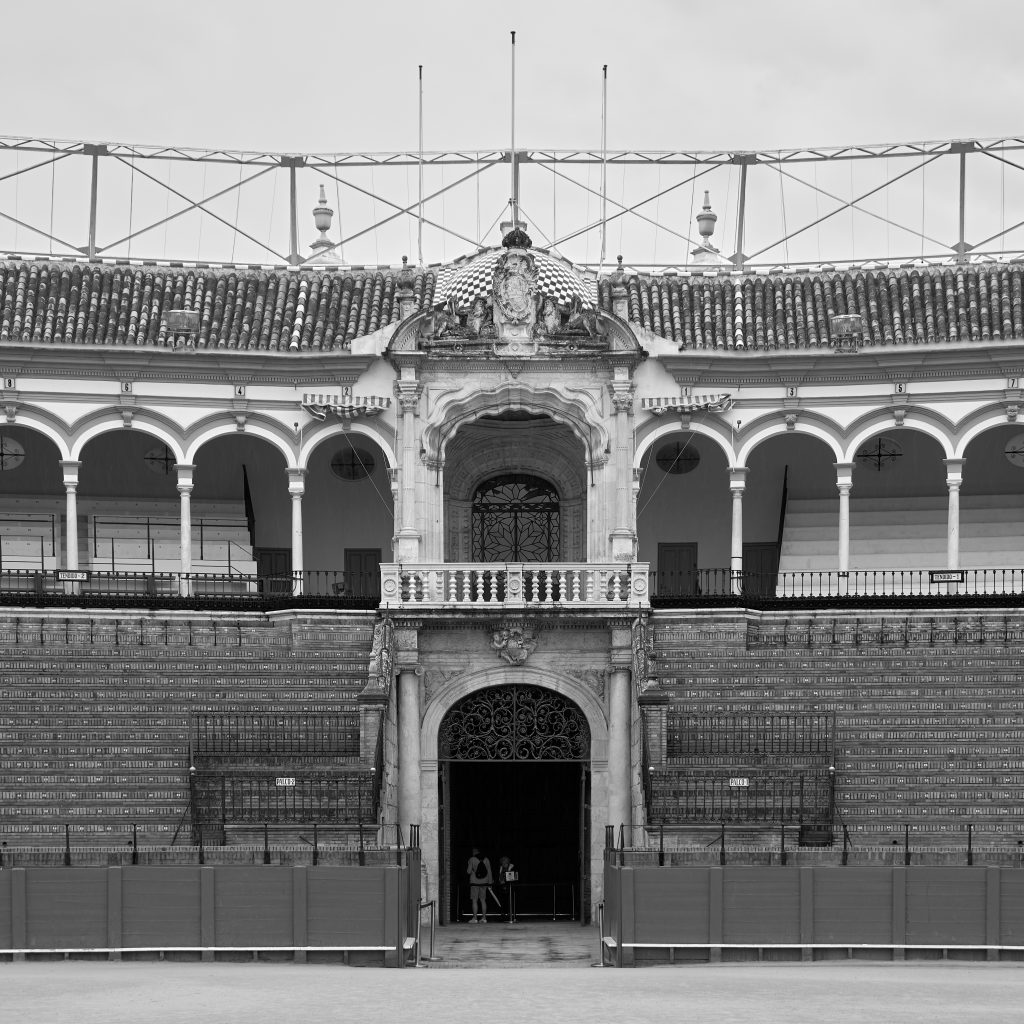
    Presenting the main Baroque façade to the river, with doors for the Maestranza nobles and civil authorities, the Prince’s Gate, is about rank, ritual and image. It states who rules the space, and who earns glory inside it.

    The inner façade dates from 1765, built for the Bourbon prince Felipe, son of Felipe V. The upper gallery is the Royal Box (Palco del Príncipe), still used by the royal family. The half-dome roof, white and blue tiles, and sculpted group on the top mark it as the visual “crown” of the arena.

    The lower part forms the main ceremonial gate into the arena. The Royal box aligns with the long axis of the ring, drawing the eye from almost every seat, and works as a “royal presence” even when no monarch sits there. The famous Puerta del Príncipe is the ritual exit that every matador wants.

    The ears and tail are awarded to a matador by the president when urged by the crowd. Since 1982, a matador must earn at least three ears in one afternoon to leave by this gate. To raise the bar for ‘celebrity’ matadors, who fight alone, they must be awarded four ears. Matadors who achieve this leave on the shoulders of their cuadrilla and fans, through that door and out to the Paseo de Cristóbal Colón.
    The Vomitoria

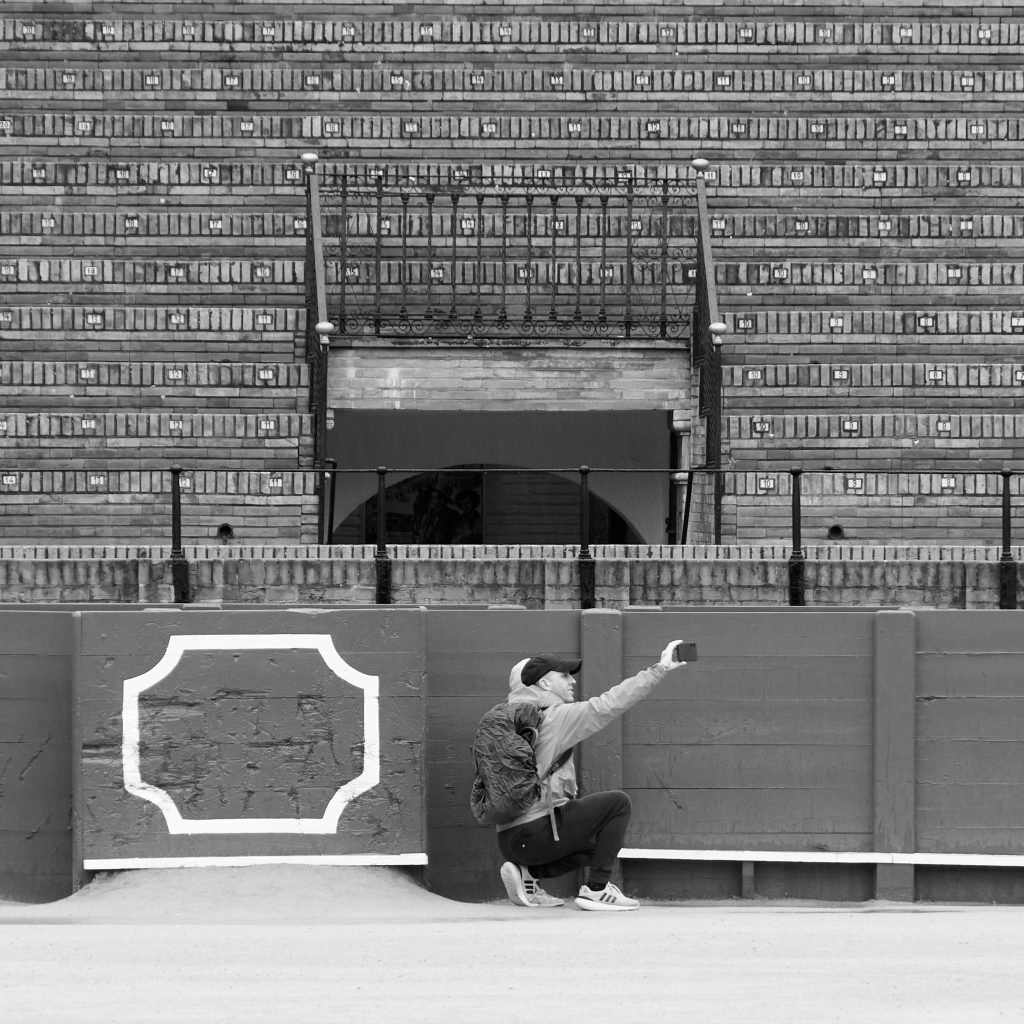
    From the street, a set of main doors around the oval façade form numbered, ticketed entrances tied to a specific tendido (section), row and seat. Spectators enter into a covered inner gallery running all round the building, from which staircases and openings feed the seating tiers both above and below.

    At the end of the corrida, stewards open the inner gates and the crowd drains down the stairs, through these galleries and out through the same numbered doors. The whole system is built for fast egress. In Roman theatres and amphitheatres, these passages and the flow of people was known as a vomitorium from the Latin vomere, “to spew forth”.

    In design terms, their job is clear: to spew out twelve thousand people into the streets of Seville once the killing stops.
    Puerta de Toriles – The Entrance of the Bulls

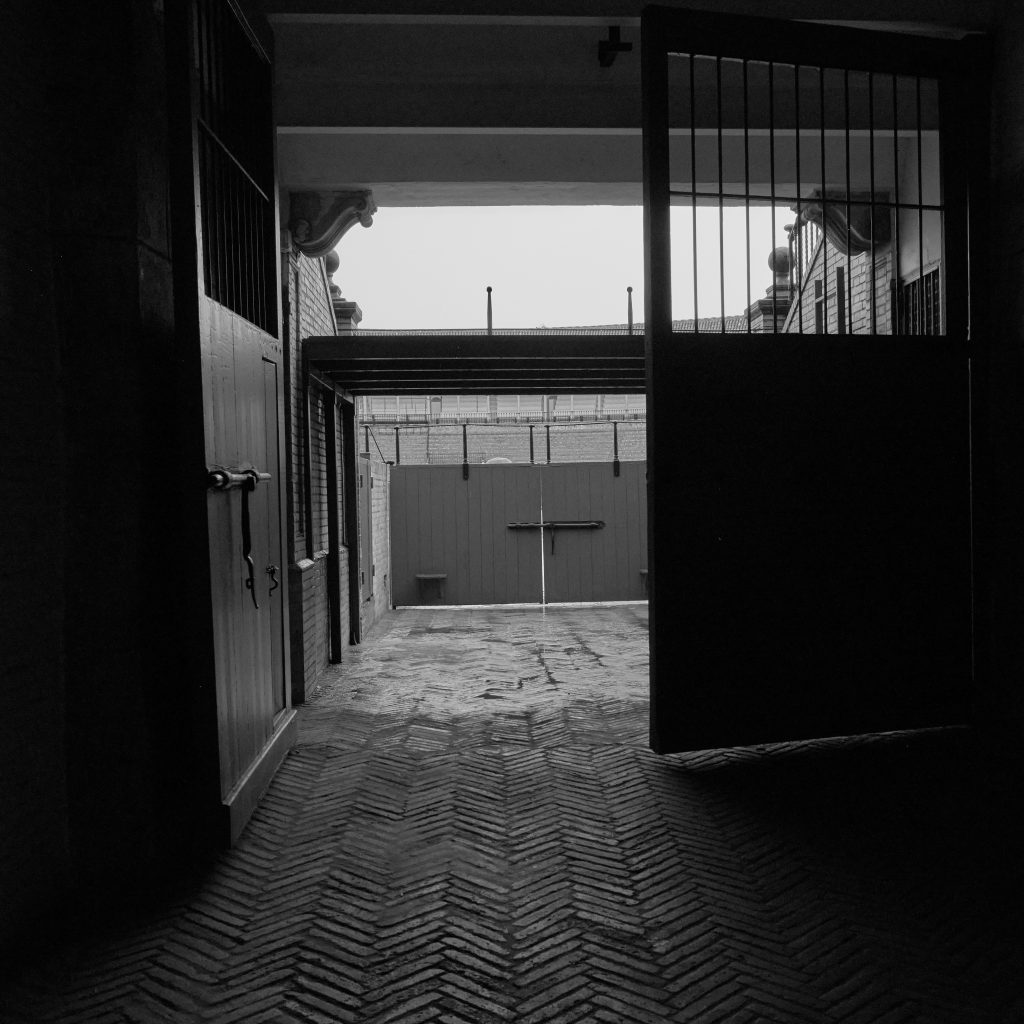
    The toriles area sits on the side of the arena that faces the Prince’s gate and Royal box. The corrales, behind this are open pens where lorries unload the herd, and from which staff sort the bulls by ranch, carrying out veterinary checks before the fight. In front of the corrales, and next to the ring wall, are the chiqueros – narrow, dark boxes that hold each bull alone before its turn.

    The Puerta de Toriles “por donde sale el toro a la plaza” – the one point where the bull can enter the ring links these chiqueros to the sand. There is a ritual built around this gate. At the start of the event, the alguacilillos on horseback ride to the president’s box to ask for the key. The president hands it down and the rider takes it to the torilero, to open the bull’s gate.
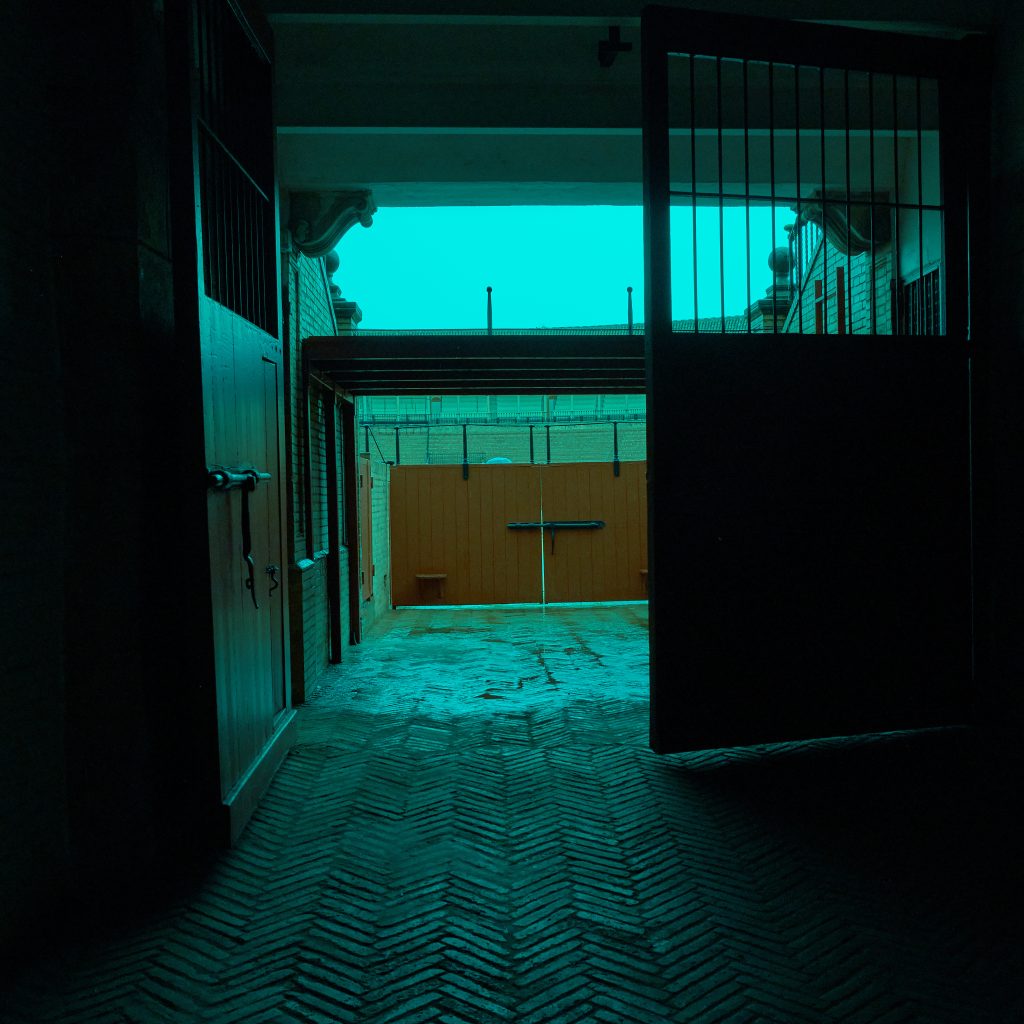
    Puerta de Toriles – The Entrance of the Bulls – The Bull’s Eye View

    It is a popular myth that bulls are colour-blind. However, bulls don’t see only shades of grey. They see fewer hues than we do, but they do not live in a grey fog.

    Cattle have two cone types in the retina. Humans have three. This means that cattle see a blue and green spectrum, but they don’t see red in the way we do. A red cloth looks dark to them. It doesn’t blaze with heat or threat. The myth took hold because matadors move the cloth. The bull tracks the motion; the shade itself has no particular power.

    This matters for two reasons. First, it shows how easy it is to frame an act of harm as a trait of the victim. The tale about bulls and red shifts blame. It hides the fact that people bait and break the bull through stress, pain, and fear. Second, it lets us ask how false ideas shape views of farm life and of the rights of non-human beings. If we treat beings as dull, we give cover to abuse.
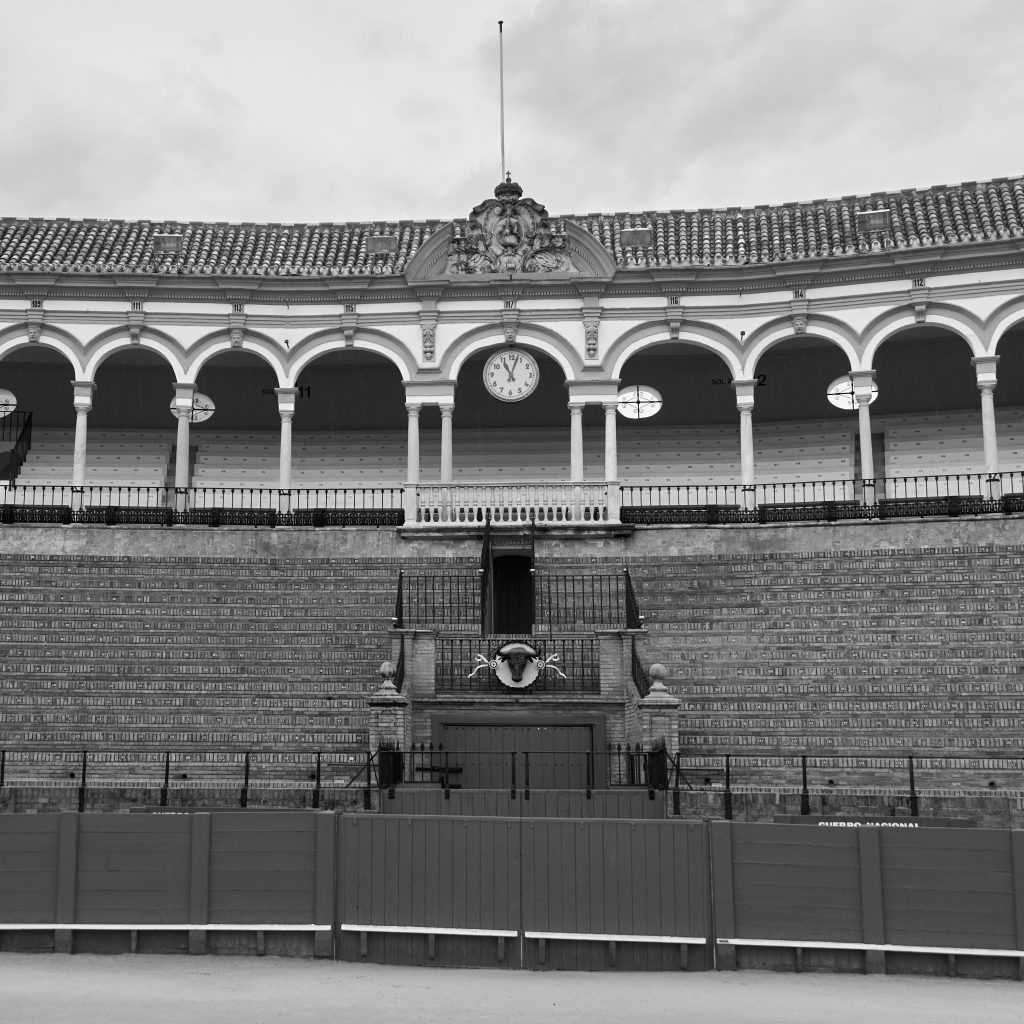
    For the animal, the shift is from a cramped dark box, through the Puerta de Toriles, to blinding light and noise. The whole design funnels that body, and the animal’s fear, to one exact point on the sand, while the crowd and the Royal box look on.

    A historic study of the Maestranza notes the “zona de toriles”, with its own balcony of the Diputación set over the toriles gate, forms a clear axis – monarchy at one end, bulls at the other.
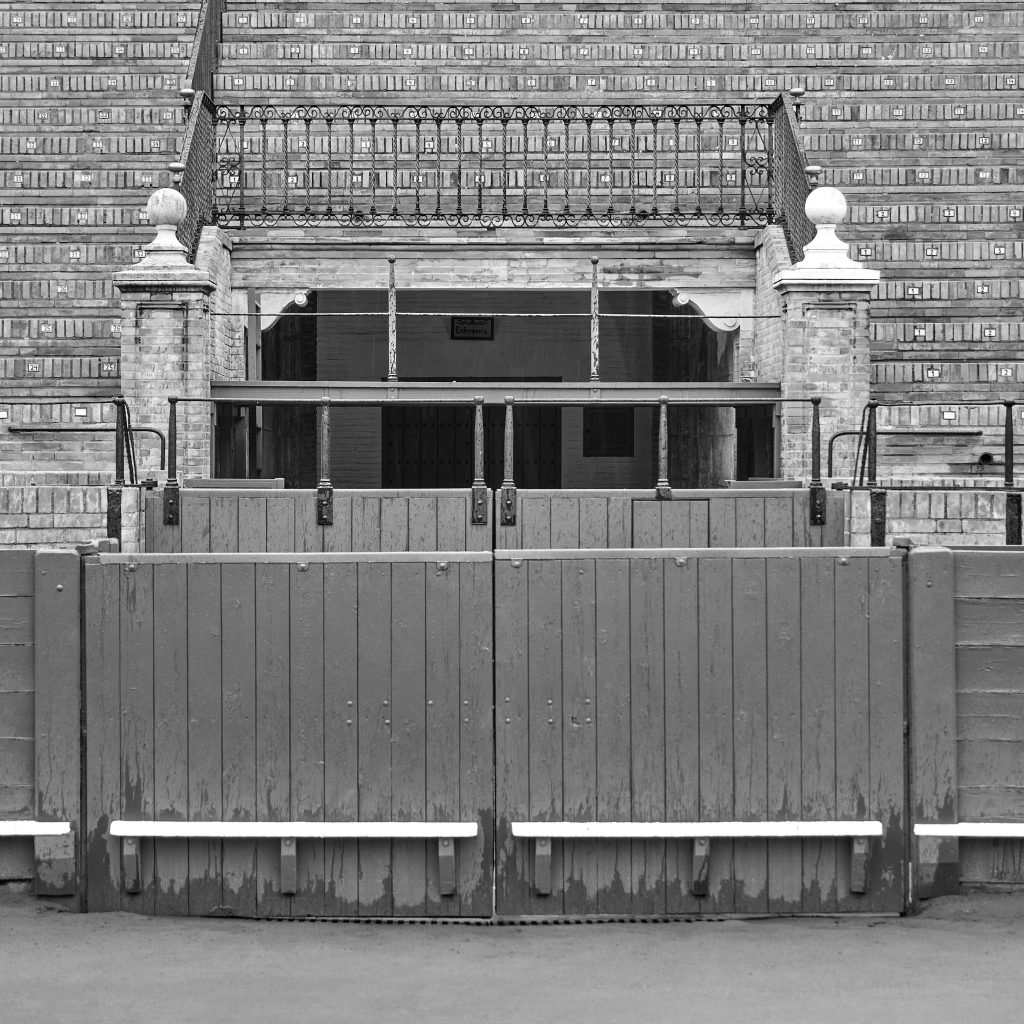
    Puerta del Despejo – The Clearance Gate

    We are told that the death of Victor Barrio in July 2016 was the first death of a matador since that of José Cubero “Yiyo” in 1985. However, matadors are the ‘nobles’ of the ring and there are also deaths (and, of course, injuries) among their team of banderillos and other ‘toreros’.  Since modern era bullfighting emerged in 1700, there have been over 500 recorded deaths. In the last decade alone, there have been four reported (Victor Barrio – July 2016, Rodolpho Rodriguez – also in 2016, Iván Fandiño – June 2017, and Manuel Maria Trindade – August 2025). None of these figures and reports address deaths among farm workers outside the ring who are breeding and rearing the fighting bulls for much of the year.

    Protection for the matador’s body, has changed little over the years. The traje de luces remains a tight silk suit tailored to show line and grace rather than padding. Some bullfighters wear light protection under the cloth, but culture still rewards a slim, ‘classic’ shape and the idea that the matador shares the bull’s exposure.

    Modern rings try to answer the risk this represents with medicine rather than armour. Spanish law now calls for full medical cover inside the plaza. Big city rings market themselves as trauma centres. Pamplona, Madrid, Córdoba and Seville all house on-site infirmaries with operating theatres, teams of surgeons, and clear triage routes from sand to surgery.

    The Puerta del Despejo had previously been used to drag out the bodies of dead horses, but the introduction of protective mantles reduced this need, and the gate was blocked up in the 1950s.  However, when the new infirmary was created in the 2000s, it was reopened along with changes to floor levels so that the path from sand to surgery was uninterrupted – its name remains appropriate.
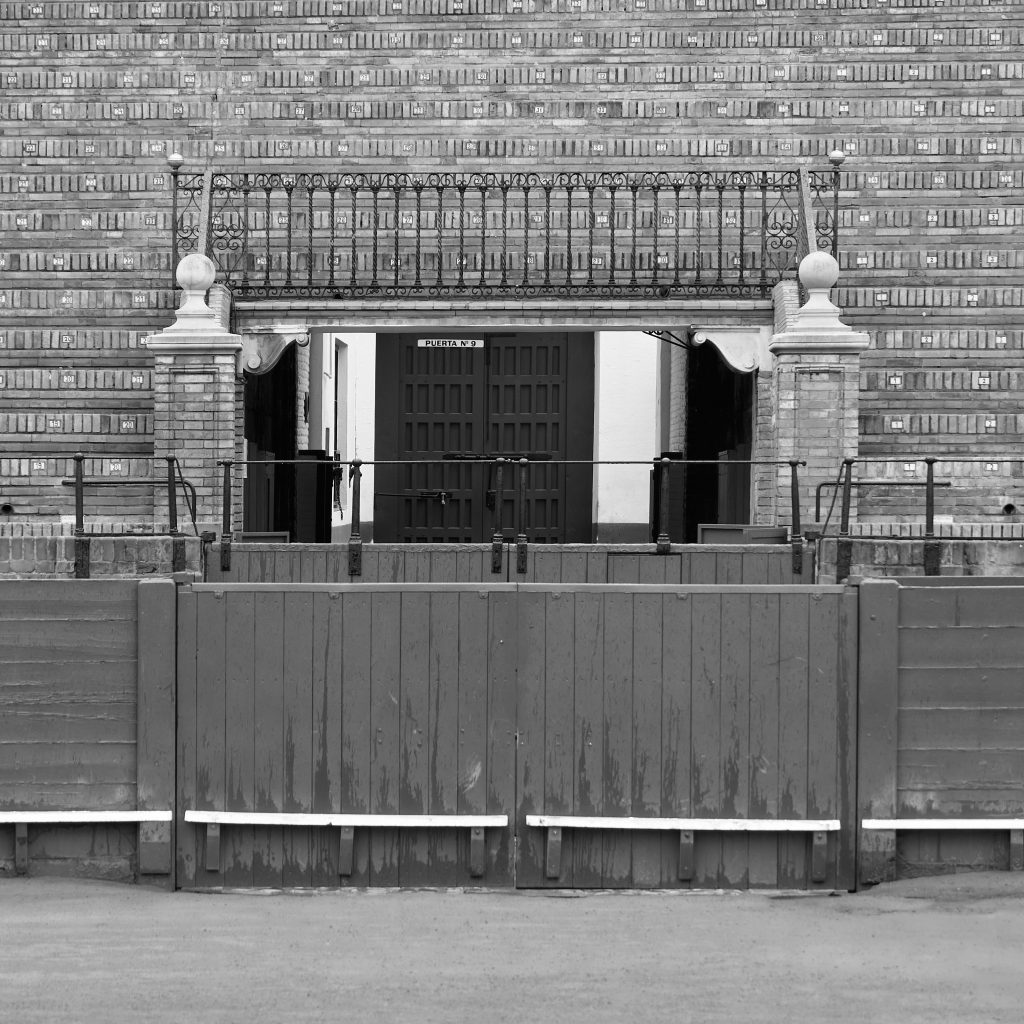
    Puerta de Arrastre – the “Dragging Gate”

    Once the bull lies still, ring staff check that it is dead. The president then calls the arrastre. A team of ‘mules’, the mulillas, come in from the patio through the puerta de arrastre, led by mulilleros in bright dress. They fix chains or a harness to the bull’s horns and set off at a brisk run. Normally, they drag the body in a straight line to the same gate. However, when the president grants a posthumous honour – a vuelta al ruedo – the team drags the bull round the full ring first.

    Thus, the dead bull leaves the ruedo through the puerta de arrastre – a low but necessarily wider gate in the barrier that opens from the sand into the patio de arrastre – the service yard that links on to the skinning room and slaughter area – the desolladero. It is in this area that any bull that still shows signs of life is finally slaughtered, skinned and the body bled in hygienic conditions and under veterinary control before it is sent for butchery in refrigerated vans. The rules and processes were ‘tightened up’ in 2001, due to ‘Mad Cow Disease’.
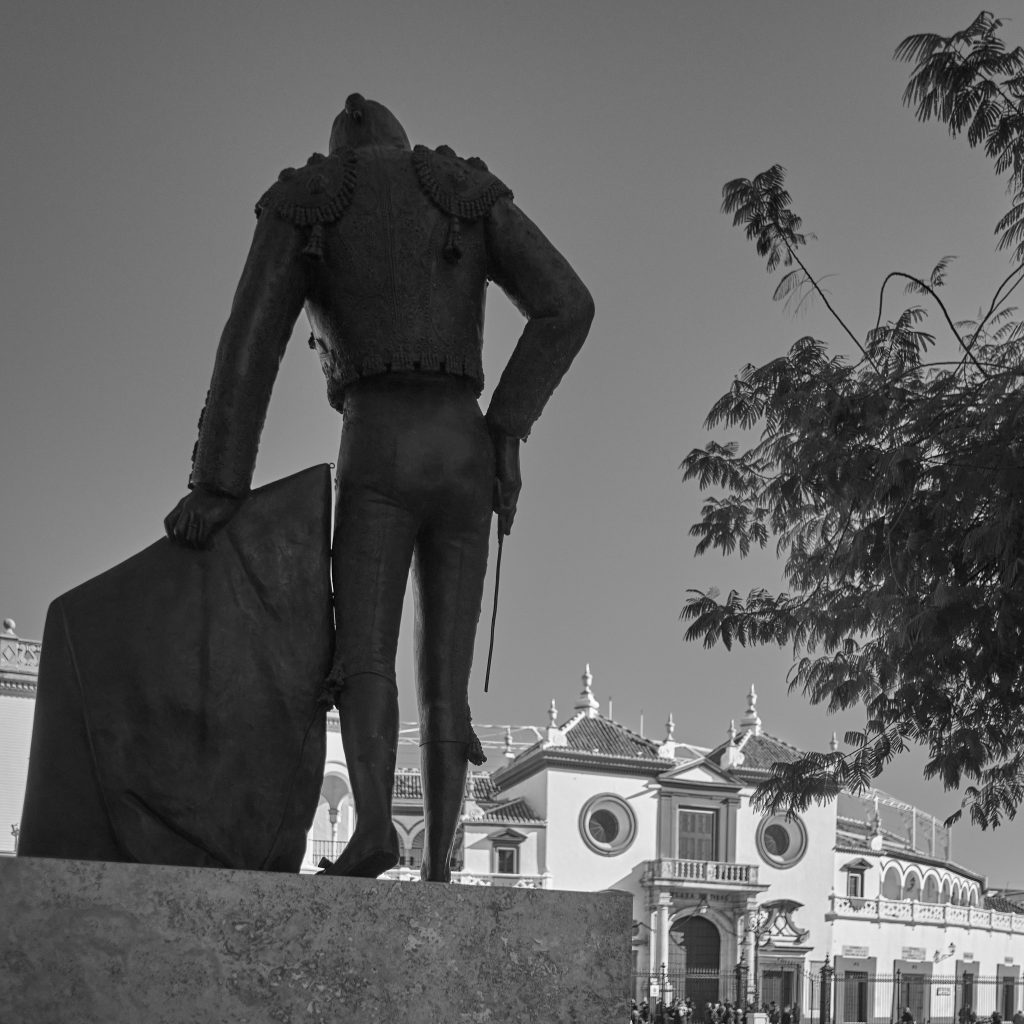
    Monument to Manolo Vázquez

    Manolo Vázquez was Seville’s house matador. Born in the San Bernardo district in 1929, he took the alternativa in the Maestranza in 1951 and fought more than 300 corridas before his first retirement at 39 years old in 1968.  He returned, at 50 in 1981, and said farewell for good in 1983 after a major ‘triumph’ in the same ring. He lived to 75, a long life in a trade marked by blood and shock. His bronze statue, opposite the Maestranza, shows him in a classic, calm pose with the muleta. Estimates vary, but he is thought to have killed between 300 and 500 bulls.

    In a classic Spanish corrida, the bull enters the ruedo once and the script says that he must die there. A “fight to the death” is built into the form of the show and into law that still treats this as a set kind of public performance.

    A bull that has fought cannot go back to farm life or face the ring again. The much-publicised “pardon” of an outstanding bull, the indulto, is a very rare exception that saves only a handful of animals each year and exists to feed breeding lines, not to soften the death rate.

    The idea that rings sit on the edge of town so that loose bulls pose less risk is folk talk more than fact. Some old plazas did start at the fringe, but many, like Seville or Pamplona, now lie in dense city streets. A fighting bull that breaks out is very dangerous, as the death toll at street runs shows, yet the rule that the bull does not leave the ring alive comes from the needs of the show and the meat trade, not from a wish to protect the town.

    In a standard corrida, three matadors face six adult bulls and all six are killed. At Seville, the 2024 and 2025 seasons listed 24 events each year – 16 or 17 full corridas plus a horse show and six novice fights – which means in the region of 140 to 150 bulls killed per season in this ring alone.

    Across Spain as a whole, animal rights groups now speak of at least 7,000 bulls killed in official rings per year, and “tens of thousands” if one adds town fiestas and linked events.

  • A kind of Photo-Roman…

    Flat Stanley on VE Day, 2020

    Flat Stanley was sent to Klint and Amanda from a primary school in Kansas. Unfortunately, he arrived a couple of days after they had left for the US to avoid travel restrictions due to Covid-19. The idea is that these coloured cut-outs are hosted by someone and returned by a certain date. So, I pulled together a few shots, added some captions, and produced a PDF “book” which was duly returned to the child responsible for sending him…

    The pictures weren’t my best, but the concept is now proven… I’m tempted to offer something like this for the Marlborough School Fun Day.

    Photo-Roman (https://fr.wikipedia.org/wiki/Roman-photo) – “A photo novel is a narrative genre close to comics, in which a succession of photographs, generally embellished with texts arranged or not in speech bubbles, leads the narration.”

    We saw the major exhibition of Photo-Roman in Marseille a couple of years ago and I was quite emotionally impressed by the impact of the idea. Had resolved to have a go one day, but hadn’t had the excuse or need.

    Incidentally, this is my second Lockdown Project completed.

  • 75th Anniversary of VE Day – Pt 2 – Celebrate?

    (to be completed)

    Celebrate /ˈsɛlɪbreɪt/ verb – to acknowledge a significant or happy, day or event, with a social gathering or enjoyable activity. “To celebrate their joint birthday, they had a big party and two cakes”.

    The 75th Anniversary

    Before the coronavirus crisis, the Government had moved the May Bank Holiday from Monday to Friday to allow a three-day commemoration consisting of a parade in London, speeches and broadcasts, a flypast by the Red Arrows, and a concert at the Royal Albert Hall.  Pubs across the country were due to remain open later, until 1am, on 8 and 9 May, while people were also encouraged to host their own street parties to get involved in what has been called the “VE Day spirit“. 

    While Armistice Day is usually commemorated, rather than celebrated, it has clearly been the intention for some time, that a celebration would be encouraged in 2020. The coronavirus crisis has, in part, thwarted this plan.

    With ‘lockdown’, all official events have been postponed until, at present, the weekend of VJ Day (August 15th and 16th).  The public are still being encouraged to take part in the ‘Nation’s Toast to the Heroes of WW2’ which takes place at 3pm on 8 May, and serves to thank those who gave their lives to ensure the freedom the country enjoys today, but to do so from the safety of their own home.

    Picnics on the front garden

    The Government department responsible for the events has now proposed that people should decorate their homes in red, white, and blue, and have a picnic “in their front garden”.

    Front gardens are a largely post-war phenomenon

    Former Manorial villages (which are typical of many rural settlements) have larger houses in the centre, often closer to the church (along with barns that have subsequently been converted), and progressively poorer accommodation further away from the Manor. The low-value properties almost always have their door directly onto the street. They have often been interspersed with, what is known as ‘regulated housing’ built between 1875 and the 1980s. The earlier of which usually also abutted the road, unless they were larger ‘villas’ which had a strip of front garden. Local authority housing, built after WW1, is virtually the only lower cost accommodation that has a front garden. A few private in-fills copied this style. However, by the 1980s, when council housing was being sold to private owners, much of this was being paved to provide standing for a vehicle, corresponding to a growth in private ownership of cars. The only examples of peripheral housing with a ‘front garden’ are private developments usually built in the 90s and 00s. Subsequent ones have smaller plots and developers again minimise the front space.

    The pattern was not dissimilar in towns, where most early development was by factory owners in close proximity to their works and mills. Until private developers began to create large estates on the edges, few had gardens let alone one in the front.

    City development is a more complex process, but again, the possession of a front garden was always, and largely remains, something that the wealthy may have, part of the middle class may aspire to, and for the majority is a pipe-dream.

    The government’s call could be, at best, a little misguided and naive, or at worst an appeal to the aspirational middle-class who they see as a pool of prospective voters.

  • 75th Anniversary of VE Day – Commemorate

    Commemorate /kəˈmɛməreɪt/ verb – to recall and show respect for (someone or something).  “A wreath-laying ceremony was held to commemorate the war dead”

    [metaslider id=”1246″]

    VE Day (8th May 1945)

    This year, 2020, is the 75th Anniversary of VE (Victory in Europe) Day.  The war would continue for some time in Asia and the Pacific, but for many Britons and their allies, this was the beginning of the end of the sacrifices that they had made for six years.  In London, the news created a wave of euphoria, and iconic photographs give the impression that everyone was celebrating.  Elsewhere, the mood was more constrained.  Many had little to celebrate.  Nevertheless, communities came together and street parties were quickly organised with rations being pooled, and bunting being made, however in the minds of all was the suffering so many had endured, and the personal loss felt by friends and neighbours. The celebration was as much a drowning of sorrows (the Government had been anticipating the German surrender and arranged for stocks of beer to be brought into the capital in secret) and an opportunity for parents to reassure their children that the suffering that had blighted their early years was now over.

    The deadliest military conflict in history

    In World War II, an estimated total of 70–85 million people died – 3% of the 1940 world population; of whom, 50-56 million were military personnel and 20-30 million were civilians.  There were a further 19 to 28 million deaths from war-related disease and famine.  Rationing would remain in place for almost a decade.

    The challenge of the home-coming

    Some 4.2 million service men and women were demobilised in Britain alone, and along with 30000 or so child evacuees, would ultimately return; many to shattered homes, broken families, and lost friends.  In her book, Stranger In The House, Julie Summers paints an emotionally charged image of the many ways in which families would be challenged after as much as six years of separation.

    There were millions of service personnel from other parts of the world who may not return home for two years, and 60 million people were refugees with no home to go to at all.  While VE day marked a turning point, the suffering was far from over for many.  Soon after the war, many parts of the world experienced massive political turmoil, economic hardship, social unrest, and significant changes in welfare, education, and the economy.

    War graves

    The cemetery in Upper Heyford contains 41 graves maintained by the Commonwealth War Graves Commission. This organisation oversees the resting places of 1.7 million Commonwealth military personnel, at 23000 locations in over 150 countries. The gravestones were made to a uniform pattern, and the layout of the cemeteries or parts of larger burial grounds were all designed with considerable thought, to preserve an atmosphere of respect and reflection. They are maintained impeccably.

    The cemetery came into use about 1919 or 1920, when the churchyard opposite ceased to be used for burials. During the early part of the 1939-1945 War ground in the south-western corner was set aside for service war burials, and was used by the RAF Station at Upper Heyford. This is now the War Graves Plot.

    The graves illustrate the role of the Commonwealth and the very young age of the volunteers signing up. Unusually, one grave appears to be a private memorial.


    Unrelated, but an interesting insight into the impact these young men had…

    https://www.centralwesterndaily.com.au/story/4539236/war-hero-to-professor-alex-jenkins-amazing-life-comes-to-an-end/

  • Burgess Field and Trap Ground Allotments, Oxford

    These two areas are good examples of re-greening initiatives, and attempts to improve biodiversity, within cities.

    Trap Grounds Allotments

    As with many other allotments, the site was used as a municipal refuse tip prior to the 1914-1918 war, and part of the site was still used for this purpose in the 1950s. Garden soil was then brought in horse-drawn carts from various places in Oxford to cap the tip, but the ground still contains scraps of debris and associated pollutants typical of urban soils.

    There are currently around 180 plots and half-plots on the site. A standard plot traditionally being 11 ‘poles’, a unit of length of exactly ​5 1⁄2 yards. There is no mains water on the site but there are a number of 2-3m deep wells.

    Burgess Field

    Burgess Field was the City Council open landfill site until the early 1980s, which explains why it stands higher than the neighbouring Trap Grounds allotments and Port Meadow itself. When it was closed, a clay cap was put in place and the area was roughly landscaped and partially planted with trees and hedges in the 1990s. The trees were carefully chosen to encourage wildlife, have since flourished, and now form the tall hedges that in 2019 have begun to be “lain down” ( https://en.wikipedia.org/wiki/Hedgelaying ) by volunteers to provide better cover for nesting birds.

    HS2

    The High Speed train line heading north out of Oxford passes beside the Trap Grounds Allotments and Burgess Field Nature Reserve. Until the line was upgraded, pedestrians wanting to access these (and Port Meadow adjacent to them) had to cross the line using a wooden sleeper based crossing. When someone narrowly escaped death, the authorities got on with the creation of a large pedestrian bridge across the lines with a substantial perpendicular bridge exclusively for the use of the allotment users.

    All told, the two developments are good illustrations of re-greening of a city even before climate change and adaptation were spoken of. They make a substantial contribution to the green lungs of the city.

  • The Oxford Canal 1769-2019

    This is the 250th Anniversary of the passing of the Oxford Canal Act 1769 which created the enterprise that would build and manage the canal. Accounts vary slightly but the Nicholson map of the canal suggests that it is 69 miles long.

    My project aims to document the canal as it is today at 1 mile intervals over the course of 2019. A variety of images, both documentary and ‘contemporary’, are being prepared and processed in different styles. The output will take shape as more images are produced.

    The southernmost point of the Oxford Canal today
    Mile 1
    Mile 7
    Mile 8
    Mile 9
    Mile 10
    Mile 11
    Mile 27
    Mile 28
    Mile 29